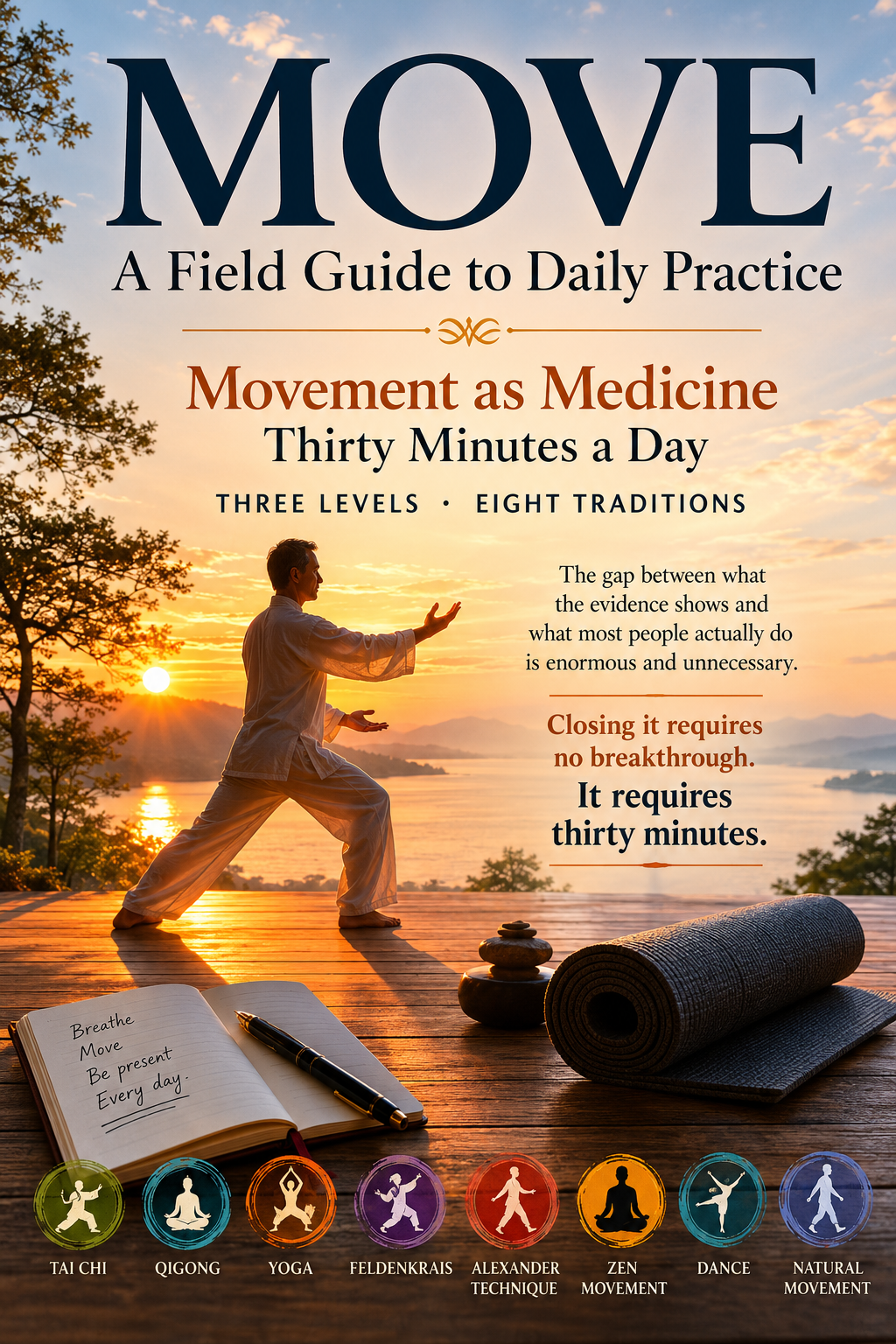
Movement as medicine. Thirty minutes a day. Three levels. Eight traditions. The complete operational manual for the body you actually have.
30 minutes that survives a real week — not a heroic Sunday.
Beginner, medium, or advanced — calibrated to today's body.
Mobility, strength, cardio, balance, nervous system.
Teens through 80+. The right protocol for the body you have.
Available now, in whatever clothes you slept in, for thirty minutes a day. No drug will replace what walking, breathing, balancing, and pushing the floor away from you does for the nervous system.
For forty years the fitness industry has cycled through the same predictable mistakes. The advice that exists keeps failing in the same ways:
Written for the people actually trying to build a sustainable practice — at every level, every age, every starting point.
You used to be fit. Life happened. You want a structured return that respects the body you have today — not the one you had at 25.
Career, kids, deadlines. The 6 a.m. gym session that worked at 24 is impossible now. You need a home practice that fits a real life.
You know the bone density data. You know the sarcopenia data. You want the practice that will keep you independent at 80.
You know the moves. You skip too many days. You want the framework that turns motivated weeks into sustained years.
You want the practice — for yourself, a parent, a client — that maintains the capacity for daily life. Tai Chi. Strength. Balance. Honest.
You want the evidence, the honest caveats, and a framework you can adapt — not a thirty-day challenge or a celebrity programme.
Each tradition taught at beginner, medium, and advanced level — with the evidence base, the daily protocols, and the YouTube channels worth investing time in.
The most-studied movement practice in medicine. Yang 24-form, push hands.
Eight Brocades. Five Animal Frolics. Liuzijue. Often the better starting point.
Yi Jin Jing. Horse stance. The foundation methods behind the monks.
Mobility-focused, religion-optional. Sun Salutation through arm balances.
Bodyweight strength. Push, pull, squat, hinge — wall push-up to planche.
The movement reset our bodies need. Crawling, climbing, ground work.
The mini trampoline, honestly assessed. Low-impact cardio with real benefits.
The ball in your office for fifteen years. Eight exercises that justify it.
Built so you can flip to your level, find what matches your day, and move. The science sits in the margins where it belongs.
Movement as medicine — the claim, the science, the bridge to today.
Five qualities. Breath. Warm-up. Tracking. When not to move.
One architecture, three levels, versions for less time.
Three styles, one principle. The 2026 evidence base.
Eight Brocades. Five Animal Frolics. Liuzijue.
Yi Jin Jing, horse stance, the foundation methods.
Sun salutation through arm balances and inversions.
Push, pull, squat, hinge — progressions to the named skills.
The vocabulary the body has not used since childhood.
Honest assessment, real benefits, what the marketing overstates.
Eight exercises plus the 90-second hourly desk reset.
Pelvic floor. Hips. Thoracic spine. Ankles. Eyes. Jaw.
Walking. Calf pumps. Inversions. Sauna. Cold.
Box. Bhastrika. Wim Hof. 4-7-8. Coherence.
Morning. Lunchtime reset. Evening wind-down. Weekend deep.
When not to move. Pregnancy. Over 60. Chronic conditions.
The habit that survives. Tracking. Going deeper.
10-question self-assessment plus decision matrix plus personal protocol card.
Teens through 80+. Pregnancy and postpartum, extended.
Apple Fitness+. Peloton. Centr. Future. Caliber. The 2026 benchmark.
Protein. Hydration. Sleep. The five supplements with real evidence.
Walking deeper. Swimming. Hiking. Forest bathing. Sun. Sauna.
The 2023 BMJ depression meta-analysis. Anxiety. Cognition. Trauma. Community.
Sit-to-rise test. Dead hang. Single-leg balance. Your movement age.
The other twenty field guides, with where to read next.
Treats daily movement as the real, large, consequential intervention it is — without the wellness-influencer aesthetic and without the medical-establishment understatement. The dose is small. The evidence is overwhelming. You are trusted with both.
2026 Nature Scientific Reports meta-analysis on Tai Chi. 2024 Larkey HRV review. 2024 ICFSR Global Consensus on older adults. 2023 BMJ depression meta-analysis. 2025 Araújo SRT mortality data. Cited where the evidence is strong; named where it is provisional.
Won't tell you to get up at 5 a.m. or commit to a heroic programme. Gives you the smallest sustainable practice that fits the life you actually have — plus the framework to grow it across decades, not weeks.
Especially clear-eyed about pregnancy, over-60s, chronic conditions, and the red flags that mean "stop and call a clinician" rather than "push through." Where movement is medicine, dosage matters.
Reference material you'll come back to, templates you can use tonight, and self-tests you can actually do at home.
25 parts, 140 chapters, 5 appendices. Read straight through or by the chapter you need right now.
Open, strengthen, mobilise, move, close. Three level versions plus 10, 15, and 20-minute variants for tight days.
Find your starting protocol in under ten minutes. Plus the personal protocol card you write by hand.
Teens, 20s, 30s, 40s, 50s, 60s, 70s, 80+. Pregnancy and postpartum trimester by trimester.
Sit-to-rise test (the 21-per-cent-per-point mortality predictor). Dead hang. Single-leg balance. Composite movement age.
Apple Fitness+, Peloton, Centr, Future, Caliber, Whoop, Oura — the honest 2026 stack-by-use-case guide.
25 vetted channels across all eight traditions. The teachers worth investing time in.
Named A–Z, grouped by tradition, cross-referenced to chapter. The quick-find table for daily use.
Under €100 essentials. Under €300 add-ons. What to skip entirely. Total recommended kit under €400.
This guide synthesises the current best evidence on daily movement — drawing on the major research bodies and the most-cited recent meta-analyses in the field:
No drug will replace what walking, breathing, balancing, and pushing the floor away from you does for the nervous system. It is the cheapest medicine ever invented — available now, in whatever clothes you slept in, for thirty minutes a day.
If the guide doesn't give you a clearer, calmer, and more sustainable way to move daily, email us within 30 days for a full refund. No friction, no exit interview. The file remains yours either way. The risk is entirely ours.
The body keeps score on consistency, not heroics. Thirty minutes a day will compound across the next thirty years.