An honest field guide to living longer well.
No supplement stacks. No $40,000 plasma exchanges. No influencer protocols. Just the handful of interventions that actually move the needle, separated from the wellness-industry noise.
What the industry sells you, vs. what the evidence actually says.
Tap any row to see what made it into the book.
❖
The interventions with the strongest evidence are also the cheapest, the most accessible, and the most boring. None of them will ever appear on the cover of a wellness magazine. All of them will add years to your life and, more importantly, life to your years. From Part I · The Honest Longevity Landscape
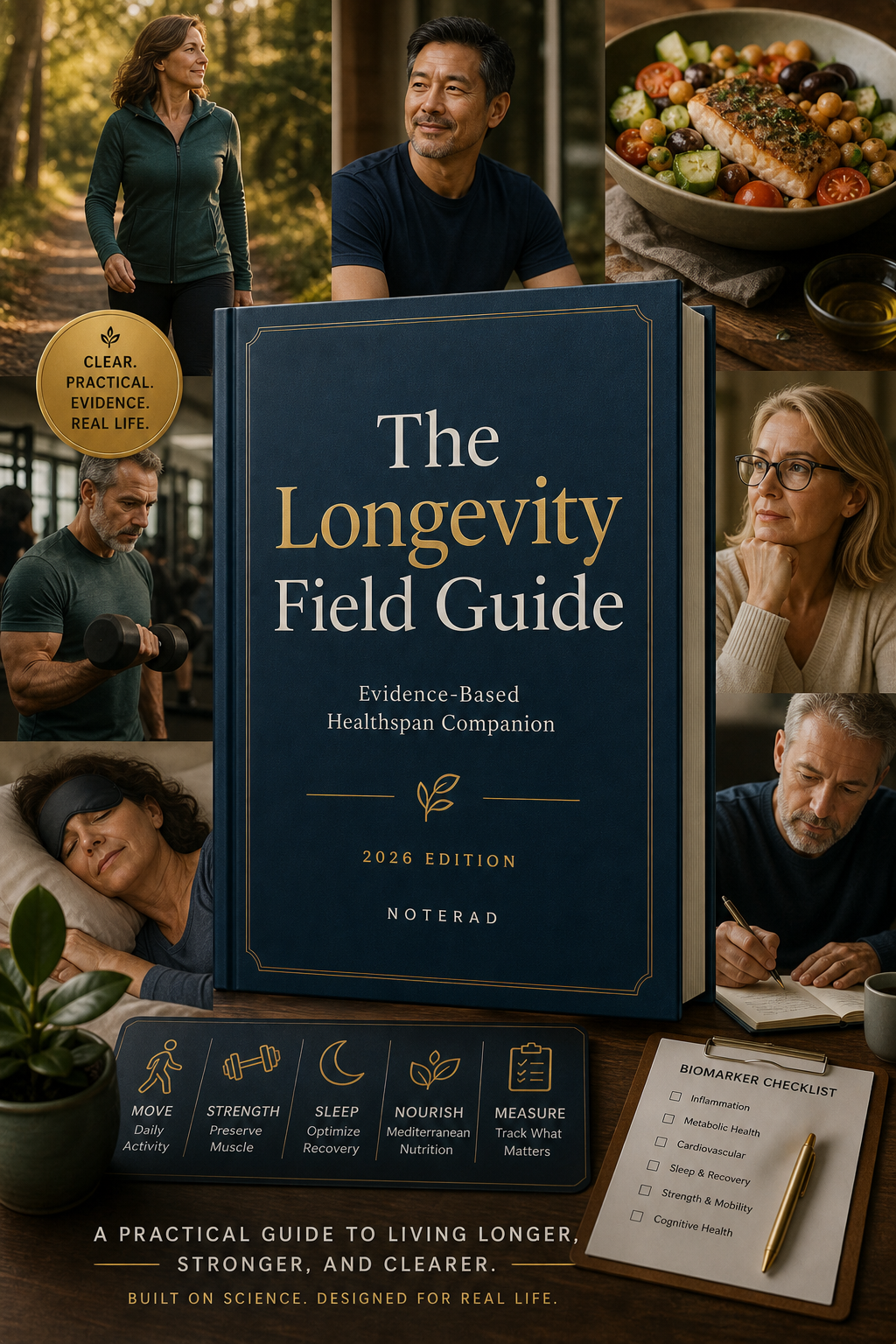
What's inside the 140 pages.
Fifteen parts plus six appendices. Tap a chapter for a preview.
The math of the $300 supplement stack.
What you spend on supplements over 30 years.
Most of that money is buying compounds without strong evidence at the doses provided. This book is $39, once.
What you actually get for $39.
A 30-day starter plan
The shortest evidence-based on-ramp. Week 1: bedtime + steps. Week 2: one strength session. Week 3: book labs. Week 4: replace one ultra-processed meal a day.
"What to ask your doctor" scripts
Literal phrasing for the apoB conversation, the HRT conversation, the bone density conversation, and the blood pressure conversation. The work goes faster when you bring the questions.
Decade-by-decade protocols
What to do in your 30s, 40s, 50s, and 60+, including which labs, which screens, which vaccinations, and which conversations matter at each stage.
The honest supplement edition
Four tiers, ranked. The handful with real evidence, the few worth considering, and the long list to skip without guilt.
Your numbers, at a glance
One reference table for every target in the book — BP, apoB, HbA1c, Lp(a), ferritin, vitamin D, TSH, T-score, VO2 max, grip strength — so you're not flipping through chapters during your physical.
Supporting an older parent
An appendix for readers who are also caregivers: the medication review, the falls audit, the cognition signs, and the one conversation worth having early.
The biohacker industry, audited
Bryan Johnson, Attia, Huberman, Sinclair, rapamycin, NAD. What's defensible, what's performance, and what to actually borrow from each.
HRT, with the post-WHI evidence
The timing hypothesis, transdermal vs. oral, micronised progesterone, vaginal estrogen, what to do if you're past the 10-year window. The conversation has moved on from 2002.
Honest about what works.
Honest about what's hype.
Honest about what we don't yet know.
This is not a wellness manifesto. It's an editorial reference. When the evidence is strong, we make a strong claim. When the evidence is mixed, we say so. When the evidence is weak or absent, we say that too.
The phrase "we do not yet know" appears throughout. Read it as a feature, not a flaw.
The book has been read by two fact-checking passes and rewritten in response to feedback from a beginner reader in her thirties and a 58-year-old woman in perimenopause — the two audiences it's meant to serve. The version you'll receive is the result of that process.
Independent Evidence-graded
Common questions, briefly.
It is a 140-page PDF e-book in the 2026 edition. You receive it as a download after checkout. Lifetime access, no subscription, no upsell.
Yes. The book opens with a "Your First 30 Days" plan written for beginners who have never thought about this before. The thirties and forties are the highest-leverage decades for compound benefit, and most of the foundation is free.
Yes. The book has dedicated parts on cardiometabolic intensification, cancer prevention, hormones (including a substantially expanded HRT chapter), bone density and fall prevention, and the consolidated 50s protocol. Persona feedback from a 58-year-old reader shaped the revision.
Pro-evidence. The book is in favour of statins, blood pressure medication, GLP-1 medications, HRT, and TRT when properly indicated. It is skeptical of expensive supplements, exotic clinics, and aspirational pharmacology without diagnosis. The distinction is the whole point.
No, and it doesn't try to. It is a guide for adults, not a prescription. The "What to ask your doctor" sections are built to help you arrive at appointments with the right questions, not to bypass them.
This is the first edition. The price will move back to $78 at the end of launch.
The marketing layer is loud.
The evidence is quiet.
140 pages on what actually moves the needle — sleep, movement, food, strength, hormones, cardiometabolic, cancer, brain, the labs that matter, and the interventions worth skipping. Read it once. Keep it as a reference for the next thirty years.