A NOTERAD FIELD GUIDE · 150 PAGES · 2026 EDITION

The Body
Reset. A field guide.

Pressure points, self-massage, gua sha, jaw release, and nervous system regulation. What works, what doesn't, and how to use your own hands.

123 chapters across 16 parts 5 appendices + 20-point reference chart 30-day starter plan included
2026 EDITION
The Body Reset — A Field Guide, a Noterad book

That viral jaw release video caught people's attention because of the reaction. The bigger takeaway is quieter than the reaction.

A lot of people are carrying more tension in their jaw, their neck, their hips, and their gut than they realise. You do not have to be a grinder or an obvious clencher for this to apply to you. Stress, posture, breathing patterns, and daily bracing load the body over time.

And no, you do not need a huge emotional release for any of this to be valuable. Sometimes the response is emotional. More often it is just tenderness, relief, or the small recognition of how tight a muscle has quietly been. That is enough. That is the work.

From the foreword · Göteborg, 2026

Sixteen parts. One hundred and twenty-three chapters. Read once, use for a long time.

PART I
Foundations
Ch. 1–6 · Anatomy, fascia, evidence
PART II
The Nervous System
Ch. 7–14 · Vagus, polyvagal, Rosenberg
PART III
The Jaw
Ch. 15–24 · TMJ, masseter, pterygoids
PART IV
The Face
Ch. 25–31 · Daily 5-min release
PART V
Neck & Throat
Ch. 32–37 · SCM, suboccipital, tech neck
PART VI
Shoulders, Arms, Hands
Ch. 38–44 · Desk-worker protocols
PART VII
Torso & Core
Ch. 45–50 · Diaphragm, psoas, QL
PART VIII
Hips, Glutes, Low Back
Ch. 51–56 · Sitting-life recovery
PART IX
Legs & Feet
Ch. 57–62 · Plantar fascia, reflexology
PART X
Gua Sha, A to Z
Ch. 63–72 · Evidence, technique, protocols
PART XI
Acupressure Points
Ch. 73–82 · LI4, ST36, GB20, PC6, ear
PART XII
Tools
Ch. 83–92 · What to own, what to skip
PART XIII
Protocols
Ch. 93–102 · Morning, evening, acute
PART XIV
Conditions
Ch. 103–112 · TMJ, headache, anxiety
PART XV
Safety
Ch. 113–118 · Red flags, contraindications
PART XVI
Integration
Ch. 119–123 · The 30-day starter

What works. What is promising. What is hype.

Each chapter names where the evidence is strong, where it is provisional, and where the marketing has run ahead of the research. A working practice does not require a settled theory.

STRONG EVIDENCE

Gua Sha & Microcirculation

The 2007 Nielsen study used laser Doppler imaging to measure a ~400% increase in skin microcirculation immediately after gua sha, persisting for hours. A 2025 systematic review of 9 RCTs (436 participants) confirms modest improvements in pain, flexibility, and inflammatory markers.

STRONG EVIDENCE

Manual Therapy for TMJ

Multiple systematic reviews show meaningful reductions in pain and improvements in jaw opening following structured masseter and temporalis work. Most readers see results within four weeks of daily practice.

PROVISIONAL

Polyvagal Theory

The clinical phenomenon is real. The specific theoretical framework was challenged in a 2026 critique by 39 researchers; Porges has responded. The practices appear to help even where the mechanism is contested — a familiar pattern in medicine. We name this honestly throughout.

MEDIUM EVIDENCE

Acupressure Points

Reasonable evidence for nausea, fatigue, certain headaches, and labour pain. PC6 is the most clinically validated acupoint in modern medicine. We cover the ten points with the best evidence and skip the rest.

A sample of how each chapter reads.

CH. 18

The external masseter release

The single most useful jaw practice in this book. Two minutes a day.

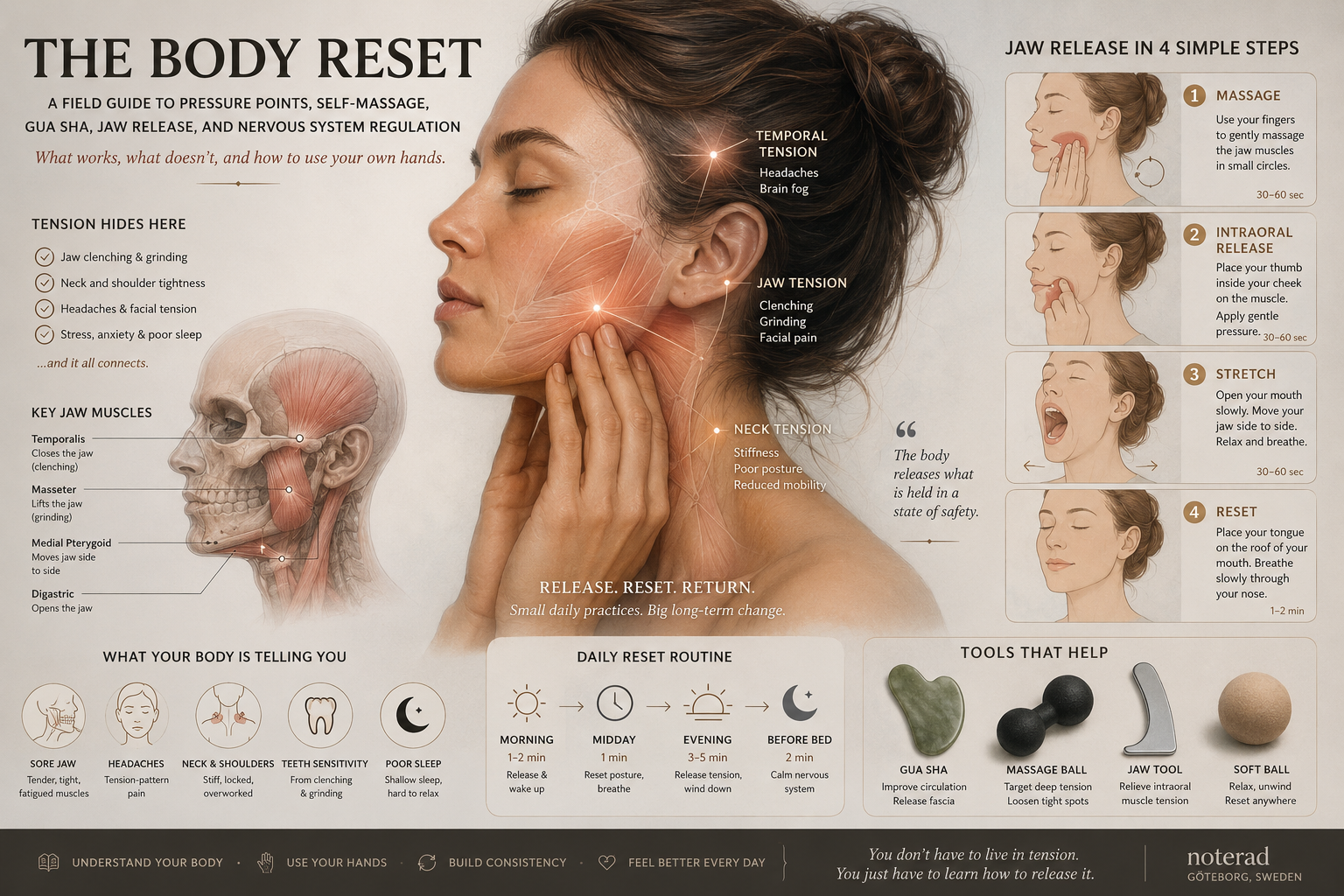
Sit upright. Place your index and middle fingers flat against the side of your face, just in front of the ear, with your jaw slightly open. Clench your teeth once and feel the masseter bulge under your fingers. That is the muscle. Unclench.

Apply moderate pressure into the muscle — a 3 to 5 on the ten-point scale. Move your fingers in small slow circles for ten seconds at one spot, then move down half an inch, then again, working from just below the cheekbone down to the angle of the jaw. Spend thirty to sixty seconds on each side.

Most people find at least one spot that is significantly more tender than the rest. That is the active trigger point. Spend an extra fifteen to thirty seconds on it, with sustained pressure, breathing slowly. Tension should fade within a minute.

Six bodies. One reference.

01

The stressed knowledge worker

Tension headaches at 4 p.m. on Thursdays. Jaw set all day without noticing. Mouse arm. Neck that doesn't quite let go on the weekend.

02

The gua sha enthusiast

Drawer of tools and conflicting YouTube tutorials. Wants the actual technique, pressure, frequency, and the order that makes a measurable difference by week two.

03

The midlife woman in perimenopause

Sleep disrupted. Anxiety baseline raised. A body that doesn't quite feel like home. The nervous system reset chapter that other perimenopause books skip.

04

The athletic recovery seeker

Foam roller plateau. Percussion gun used wrong. Wants honest answers on what each tool can and cannot do, and the protocols that actually move recovery.

05

The anxious adult looking for somatic tools

Stuck in low-grade fight-or-flight. Wants nervous-system practices that work, without the trauma-framed packaging or the breakthrough-or-bust promise.

06

The TMJ or chronic-pain sufferer

Has tried the night guard. Done the stretches. Wants the 20 minutes per week that change the trajectory, plus the honest list of what only a clinician can do.

One field guide. Yours forever.

PDF, EPUB, and Word formats. Instant download. Lifetime updates. 30-day no-questions refund.

30-day refund · The file remains yours even after a refund · Secure checkout

A few things readers ask first.

Is this another vagus nerve / somatic book?
It is broader. The vagus nerve work is one part of one of sixteen parts. The book covers the jaw, the face, the neck, the shoulders, the torso, the hips, the legs, gua sha, acupressure, tools, protocols, conditions, and safety, in one calm reference. If you have read Stanley Rosenberg, this is the book that picks up where his ends.
Do I need to buy tools to use it?
No. Almost everything in the book starts with your hands. Tools earn their place when they can do something hands cannot, and the book is clear about which those are. The total recommended kit costs under €50, and the book also has a chapter on what to skip.
I have a medical condition. Is this safe?
Part XV is dedicated to safety, contraindications, and when to see a professional rather than a book. The book is explicit about pregnancy, anticoagulant medication, recent surgery, TMJ pathology, and the conditions where self-work is appropriate versus where it is not. When in doubt, the answer is always: ask a clinician first.
How long until I see results?
For acute tension (headache, stiff neck, anxious surge), often within the same session. For chronic patterns (jaw clenching, lower-back tightness), most readers report meaningful change in two to four weeks of daily practice. For postural remodelling, six to twelve weeks. The book is honest about timelines and does not promise overnight transformation.
Is this for women or for men?
Both. The face and gua sha chapters draw a wider women's audience; the jaw, hip flexor, and athletic recovery chapters draw a wider men's audience; the nervous-system work serves everyone. The voice is gender-neutral throughout.
What format is it, and how do I get it?
It is an instant digital download. The moment your checkout completes, you get the guide in PDF, EPUB, and DOCX — readable on your phone, tablet, e-reader, or desktop. You keep lifetime access and every future update to this edition.
Can I share my copy?
The file is licensed for personal use by a single reader, which is how Noterad funds the next edition and the next book. If a friend or partner wants their own copy, please send them to noterad.com — multi-copy discounts are available on request for couples and small clinical practices.
No drama. No breakthrough required.

Just the quiet daily work of meeting yourself in your own skin.

Get the Field Guide — $39