NoteradField Guides $78$39·Get the book
2026 Edition · 95 Pages · Instant PDF

The book on adult ADHD
you actually needed
at 2 a.m.

A 95-page field guide for late-diagnosed adults. Honest about medication, comorbidities, hormones, trauma, and the grief no one warns you about. Written without the superpower nonsense, the supplement pitches, or the influencer tone.

$39 $78 Save $39 · launch price
Add to cart & checkout
Instant PDF download 30-day money-back No subscriptions
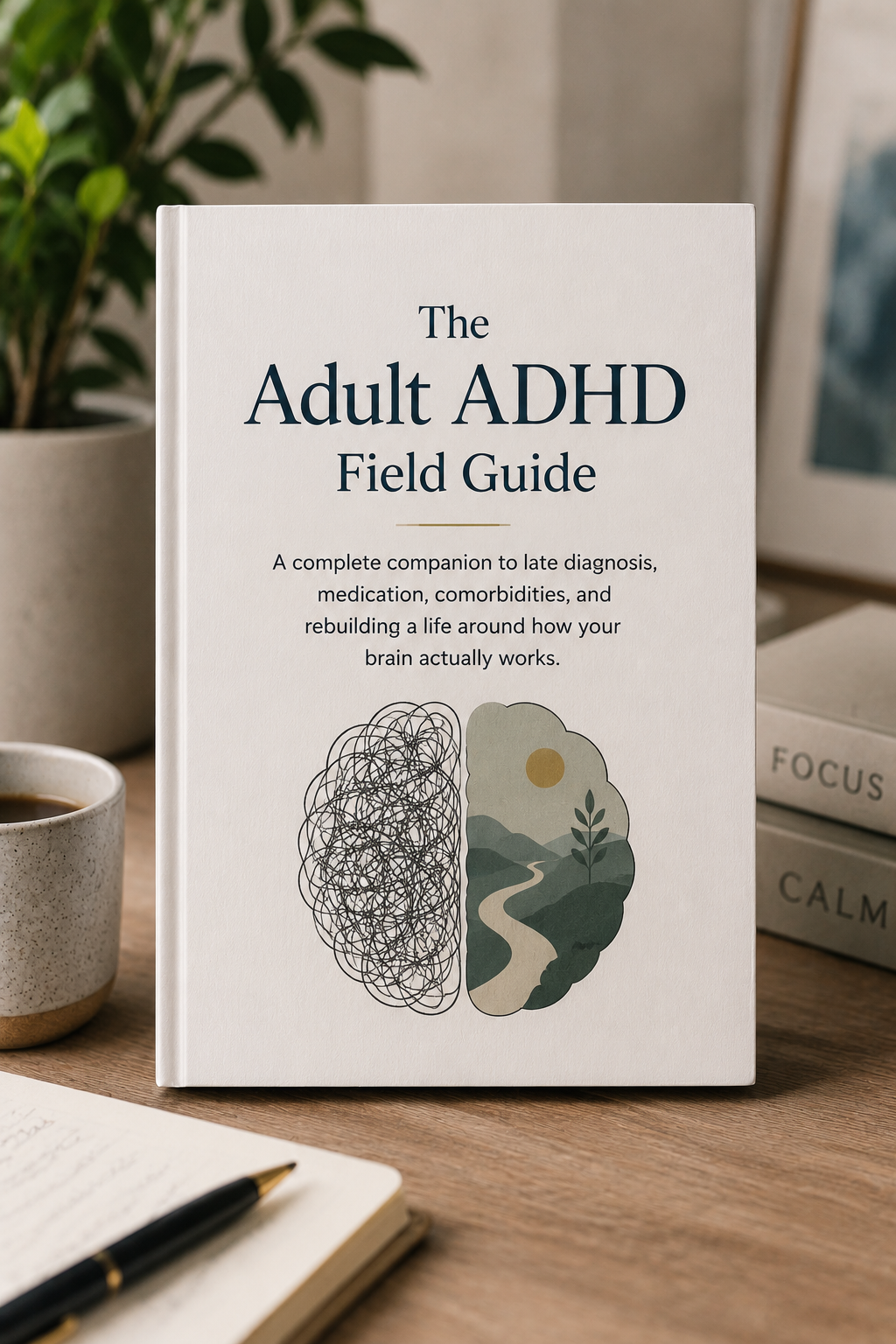
The Adult ADHD Field Guide cover
95 pages  ·  ~31,000 words
15 parts · 5 appendices · 30 Q&As
the field guide we wish
existed when we needed it.
If any of this lands

You've been reading ADHD content for six months and you're still confused.


You took the ASRS. You scored high. You don't know what that means or what to do about it.

You were diagnosed three weeks ago and your prescriber didn't have time to explain why your appetite vanished, what the late-afternoon dip is, or how to tell a crash from anxiety from an under-corrected dose.

Your partner is patient but tired. Your TikTok feed says you have a superpower. Your GP isn't sure adult ADHD is even real. The leaflets the clinic handed you say "talk to your prescriber" and nothing else.

If you have spent forty years thinking you were lazy, dramatic, or simply broken in some unspecified way, this is the long, calm, honest book that was missing.

It does not pitch you a supplement. It does not tell you ADHD is a superpower. It does not promise a productivity system that will fix your life in seven days. It takes the science as established, takes the over-diagnosis question seriously, and walks you through diagnosis, medication, comorbidities, hormones, trauma, relationships, work, and the practical toolkits the prescriber never had time to mention.

Noterad, Göteborg · 2026
Inside the field guide

Fifteen parts, written the way a careful clinician would write to a careful patient.

No bullet-point listicles. No filler. Prose you can actually read straight through, with reference tables and a glossary for the parts you'll come back to.

I.

What ADHD actually is

The neurobiology, the executive function model, and what the cliché gets wrong.

II.

How it presents in adults

The three presentations, hyperfocus, time blindness, the female-presenting pattern, and the masking that hides everything.

III.

The late-diagnosis wave

Why now, the conditions that look like ADHD, and the over-diagnosis question, honestly.

IV.

Getting properly diagnosed

What a good assessment includes, what a bad one looks like, and the self-screener you can take right now.

V.

The medication landscape

Every stimulant and non-stimulant, what each one does, and how to think about choosing.

VI.

On medication

Titration, the first ninety days, side effects, the crash, and the triage rubric for what you're actually feeling.

VII.

Comorbidities, honestly

Anxiety, depression, RSD, autism overlap, sleep, eating, substance use, and what to treat first.

VIII.

Women across the lifespan

The missed generation, hormonal cycles, pregnancy, perimenopause, and the daughter problem.

IX.

Trauma & misdiagnosis

What ADHD looks like when complex trauma is also present, and how to hold both at once.

X.

Beyond medication

CBT for ADHD, coaching, environment design, exercise, sleep, and what's honest about supplements.

XI.

Money, work, the executive tax

The boom-and-bust career, ADHD-friendly financial systems, workplace accommodations and the law.

XII.

Relationships

The partner dynamic, parenting, friendship, RSD in close relationships, and how to talk to your child.

XIII.

Practical toolkits

Time-tracking calibration, focus tools, morning & evening routines, weekly review, travel with stimulants.

XIV.

ADHD across the lifespan

The transition to adult care, the mid-career window, post-fifty, late-life recognition.

XV.

FAQ + 5 appendices

30+ honest Q&As, glossary, medication comparison tables, accommodation templates, reading list.
This book takes the existence and clinical reality of ADHD as established.
It also takes seriously the questions about over-diagnosis.
Both can be true at once.
From the editorial note
A page from the book

What a working dose actually feels like.

A short excerpt from Chapter 28: Titration, the First Three Months, the chapter readers say they wish they'd had on day one.

No fluff. No filler. The book reads like this throughout.

What a working dose feels like

Patients describe several distinct experiences when the dose is right. The mind goes quieter, with the constant background noise of unfinished thoughts becoming manageable. Task initiation gets easier, as the transition from intention to action shrinks. Engagement with non-engaging tasks becomes sustainable, so the tax form, the chore, and the form-filling become possible without a fight.

Emotional reactivity drops, with frustration arriving slower and recovering faster. And many patients describe a paradoxical calm, which is itself a strong indicator that the diagnosis was correct…

What you get

One PDF. Eight things you can't find together anywhere else.

The book is a single, well-typeset PDF. No app, no login, no subscription, no upsell. Yours to keep, reread, and share with your prescriber if you want.

95pages
31kwords
15parts
30+Q&As
  • 01
    The full 95-page field guideSet in serif typography, designed to read straight through or skim by chapter.
  • 02
    The ASRS-v1.1 self-screenerThe validated six-item WHO screener, with scoring and a frank statement of what it does and doesn't mean.
  • 03
    Medication comparison tablesEvery stimulant and non-stimulant, durations, mechanisms, and typical adult starting doses.
  • 04
    First-ninety-days timelineWeek-by-week expectations for stimulant titration, with a triage rubric for the symptoms you're actually feeling.
  • 05
    Workplace accommodation templatesSample letters and disclosure scripts you can edit and send.
  • 06
    Plain-English glossaryEvery clinical term defined the way a friend who happens to be a clinician would explain it.
  • 07
    30+ FAQs on diagnosis, meds, hormones, workThe questions adults actually ask, with the answers prescribers don't have time to give.
  • 08
    Free updates to the current editionThe field moves; your copy stays current. New editions emailed to buyers at no extra charge.

What early readers said

The first ADHD book I've read that didn't try to sell me a supplement or tell me I was a superhero. I finished it in two evenings and immediately bought a copy for my sister.

Anna L.Late-diagnosed, age 38

Chapter 28 alone is worth the price. It saved me three weeks of doom-Googling at 2 a.m. and probably one panicked email to my psychiatrist.

James M.Diagnosed 6 weeks ago, on lisdexamfetamine

I'm a GP. I've started recommending this to every adult patient who comes in suspecting ADHD. It does, in a single document, what I cannot do in a fifteen-minute appointment.

Dr. Helen R.NHS general practitioner
Limited launch price

Buy it once. Keep it for the rest of your life.

No subscription. No login. No app to download. No upsells. Just the PDF, instantly, delivered to your inbox, yours to read and reread and email to your prescriber.

50% off launch · ends soon
$39 $78
One-time payment · PDF · Free lifetime updates
Add to cart & checkout
Instant download 30-day refund Secure checkout
30 Day refund

If it doesn't earn its place on your shelf, we'll refund you.

Buy the book. Read it. If it doesn't tell you something you didn't know, or help you make sense of what is happening to you, write to us within thirty days and we'll refund every cent. Keep the PDF. We trust you. Honesty is the only sustainable position in a field that has been let down too many times by its loudest voices.

Frequently asked questions

Is this medical advice? +
No. This is a field guide, not a prescription. It's the long-form patient companion your clinician didn't have time to write. Every decision about diagnosis, medication, dose, and adjustment belongs with a licensed clinician who knows your medical history.
What format is it? +
A single, well-typeset 95-page PDF. Works on every device with a PDF reader: laptop, tablet, phone, e-ink reader, or printed. No app, no login, no DRM.
When do I get it? +
Immediately. The download link arrives in your inbox the moment your payment clears, usually within seconds.
Is it useful if I haven't been diagnosed yet? +
Yes. Part IV and Chapter 16 are written specifically for the person at the suspicion stage, including a validated self-screener and a frank section called "when your suspicion is probably wrong." The book takes the over-diagnosis question seriously and helps you think about your own case rather than just tell you that you have it.
Is it useful if I was diagnosed last week? +
Yes, possibly more so. Parts V and VI walk you through the medication landscape, what a working dose feels like, the first ninety days week-by-week, side effects, the crash, and a triage rubric for sorting out what you're feeling. The book has a dedicated reader path for the newly diagnosed in the front matter.
Who wrote it? +
Noterad, an independent publisher based in Göteborg, Sweden. We write the books we wish had existed when we needed them. We don't sell supplements, coaching programmes, or subscriptions, and we don't take money from anyone who does.
What if I don't like it? +
Email us within 30 days for a full refund. Keep the PDF. We'd rather lose the sale than the trust.
One last thing

The exhaustion was not your fault.
The diagnosis is a starting point, not an identity.

If you have read this far, you already know whether this book is for you. The work that follows the diagnosis is real, but it is not infinite, and most adults who do it say it transformed their lives in ways they did not expect.

$78$39
Add to cart & checkout
Instant PDF 30-day refund Free lifetime updates
$78$39
Add to cart