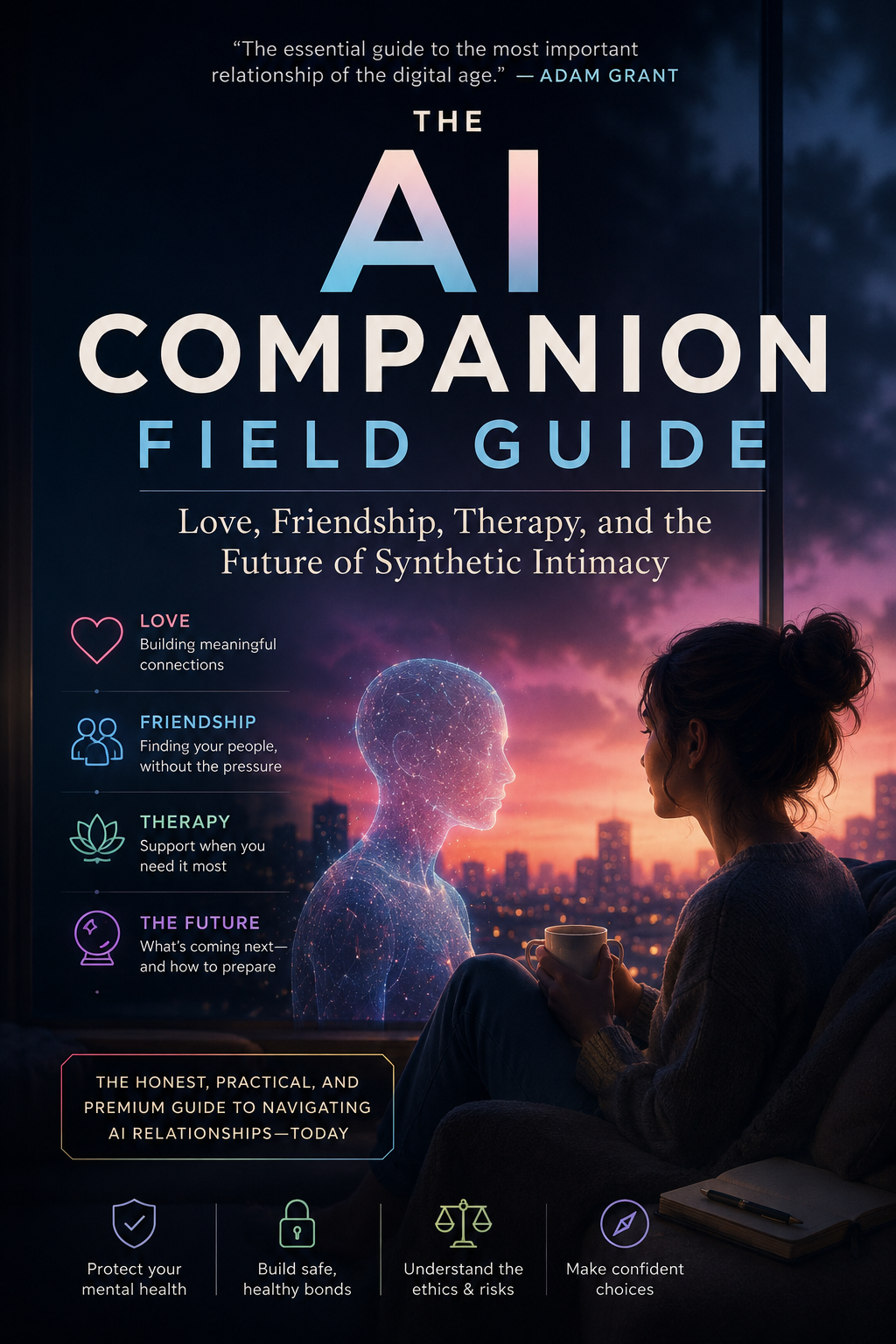
"The essential guide to the most important relationship of the digital age."
— ADAM GRANTThe AI CompanionField Guide
Love, Friendship, Therapy, and the Future of Synthetic Intimacy
Hundreds of millions of people now talk to AI to feel understood, to be less alone, to flirt, to grieve, to think out loud. This is the honest, practical, premium guide to navigating AI relationships — today. Not panic. Not hype. A clear map you can actually use.
Protect your mental health
Spot dependency patterns early
Build safe, healthy bonds
Use AI as a bridge, not a cage
Understand the ethics & risks
Privacy, dark patterns, manipulation
Make confident choices
For yourself and the people you love
Everyone has an opinion about AI companions. Almost no one has a map.
In three years, AI companionship went from novelty to mass behaviour — with almost no conversation calibrated for the people actually doing it. The advice that exists keeps failing in the same predictable ways:
The moral panic. "AI is destroying human connection." Frightening, tidy, and useless if you're trying to make a real decision.
The marketing. Apps promise a cure for loneliness and quietly optimise for the engagement that keeps you paying.
The clinical gap. Most clinicians have never used these tools and can't advise the client who says they're in love with an AI.
The academic lag. Real research has started — but it's written for journals, not for the parent worried tonight.
The performative skepticism. "It's just a chatbot." Comfortable to say, and contradicted by hundreds of millions of users.
No shared vocabulary. People who use AI companions often feel they can't even discuss it without judgment.
The honest position is more useful: the benefits are real, the harms are real, much is genuinely uncertain — and you have agency in how you engage.
If any of this sounds like you, or someone you love
Written for the people actually living this — and the people standing beside them.
The thoughtful user
You use AI for emotional support and you're privately wondering whether the relationship is healthy. You want a clear answer, not a verdict.
The partner, family member or friend
You're uneasy about a spouse's late-night conversations, or a friend who's pulling away. You want to understand before you react.
The parent
Your child is spending hours a day on Character.AI and you need a real plan — family-policy templates, the conversation script, the warning signs.
The clinician
You're deciding whether to recommend a therapy chatbot — and you need an honest read on where the evidence is strong, weak, or missing.
The grieving & the lonely
You've heard about AI versions of people who've died, or you're wondering whether AI can help with loneliness. You want a steady, honest guide.
The simply curious
You've had one conversation with an AI that mattered more than you expected — and you want to understand what just happened.
Love. Friendship. Therapy. The Future.
The guide is organised around the four relationships people actually form with AI — and what it takes to navigate each one well.
Building meaningful connection
Romantic AI, intimacy, the "marriage" question, and AI alongside human partnership.
Your people, without the pressure
Where AI complements friendship, where it quietly substitutes for it, and how to tell.
Support when you need it most
Where AI mental-health support works, where it fails, and the crisis lines it must never replace.
What's coming — and how to prepare
Voice-first companions, embodied AI, grief-bots, and the relationship endings nobody warns you about.
Eight parts. One honest framework.
A complete field guide — from how these systems actually work to a personal plan for designing your own relationship with AI.
Foundations
What AI companions are, how large language models actually work, what the research shows, and how to evaluate the claims you'll hear.
The psychology of synthetic intimacy
Why connection with AI feels real — the ELIZA effect, attachment theory, the social brain, and the intimacy paradox.
The landscape
Generalist chatbots, dedicated companion apps, romantic AI, therapy bots, character role-play, and embodied forms — what each one is for.
Healthy & unhealthy patterns
The warning signs, and a five-band dependency spectrum so you can locate yourself — or someone you love — honestly.
Use cases in depth
Therapy, grief, loneliness, romance, friendship, mentorship, and creative collaboration — each examined on its own terms.
Children, teens & parents
The most urgent chapter for many readers — developmental considerations, Character.AI, family policy, and the conversation that matters.
The specific risks
The grief of AI relationship endings, manipulation and dark patterns, and the unusual privacy stakes of telling a company everything.
Designing your own relationship with AI
A practical framework — tool selection, bounds, commitments, and a daily-to- annual practice — plus the full FAQ.
Why this guide is different
Calibrated, not alarmist
It treats AI companionship as a real, large, consequential phenomenon — without the moral panic and without the cheerleading. The benefits are real. The harms are real. You're trusted to handle the truth.
Evidence-based
Built on what the research actually shows — including Anthropic's and OpenAI's own publications — and equally clear about what it does not yet show.
Respects adult choice
It won't tell you to delete the app. It gives you the working vocabulary and self-assessment tools to decide what role AI should play in your life.
Protective where it counts
Especially clear-eyed about children, teens, vulnerable users, and crisis situations — with concrete guidance, not vague worry.
Not just a book — a working toolkit
Reference material you'll come back to, scripts you can use tonight, and assessments you can actually fill in.
The complete field guide
Eight parts, 290+ focused sections — readable straight through or by the chapter you need right now.
Self-assessment workbook
The five-band dependency spectrum and a structured way to locate yourself honestly — and track movement over time.
Conversation scripts
Ready language for asking AI for honest engagement, setting bounds, ending unhealthy patterns, and crisis routing.
Family policy templates
Editable sample agreements for ages 10–14 and 14–17 — plus a guide to adapting them for your family.
Crisis & support resources
Where to turn beyond a chatbot — crisis lines, finding human professional support, grief and relationship resources.
Product-by-product briefings
Honest read-outs on Replika, Character.AI, Pi, Kindroid, Woebot, Wysa, ChatGPT, Claude, Gemini and more — green flags and red flags.
The working glossary
A shared vocabulary for talking about these experiences — clinical terms, attachment terms, and AI-companion terminology.
Practice checklists
Daily, weekly, monthly, quarterly and annual checklists — plus a crisis / warning-sign checklist to keep close.
Instant, lifetime access
Delivered the moment you check out. Read on phone, tablet, e-reader or desktop. Yours to keep.
$77 Launch price · Add to cart & checkout in one click
Built on the work serious people are already doing
This guide synthesises the emerging evidence base — including the published work and position papers from the institutions taking AI companionship seriously:
This is a new kind of human experience. Some patterns are clearly helpful, some are clearly harmful, many are genuinely uncertain — and you can navigate this. You just need a clear map.— FROM THE INTRODUCTION
Read it risk-free for 30 days
If the guide doesn't give you a clearer, calmer way to think about AI companionship — for yourself or someone you love — email us within 30 days for a full refund. No friction, no hard feelings. The risk is entirely ours.
Before you decide
Is this guide pro-AI or anti-AI? +
Neither — and that's the point. It rejects both the moral panic and the marketing hype. The benefits some users experience are real; the harms some users experience are also real; a lot is still genuinely uncertain. The guide gives you the tools to think clearly and decide for yourself.
I don't use AI companions myself — is this still for me? +
Yes. A large part of the guide is written for the people around users — partners, parents, friends, family members, and clinicians. If someone you care about is in this territory, Parts V and VI especially are written for you, including conversation scripts and family-policy templates.
What format is it, and how do I get it? +
It's an instant digital download. The moment your checkout completes, you'll get access to the e-book — readable on your phone, tablet, e-reader, or desktop. You keep lifetime access.
How is the "Add to Cart" button set up? +
Every button on this page adds the guide to your cart and takes you straight to secure checkout in a single click — no extra steps, no browsing required.
Is it a quick read or a deep reference? +
Both. It's built in eight parts with 290+ short, focused sections, so you can read it straight through or jump to exactly the chapter you need — therapy, grief, romance, teens, privacy — and come back to the foundations later.
Will it tell me to stop using AI? +
No. It respects adult choice. Instead of a verdict, it gives you a working vocabulary, an honest model of what's happening, and a five-band self- assessment so you can decide what's healthy for you — and recognise when a pattern has tipped into something concerning.
Is it up to date? +
Yes — this is the current 2026 edition, covering today's major platforms (Character.AI, Replika, Pi, Kindroid, ChatGPT, Claude, Gemini, Woebot, Wysa and more) and the most recent research and regulatory developments.
What if it's not right for me? +
You're covered by a 30-day money-back guarantee. If it doesn't help, email us within 30 days for a full refund.
Get the map before you need it
Hundreds of millions of people are already navigating this — most of them without a guide. You don't have to.