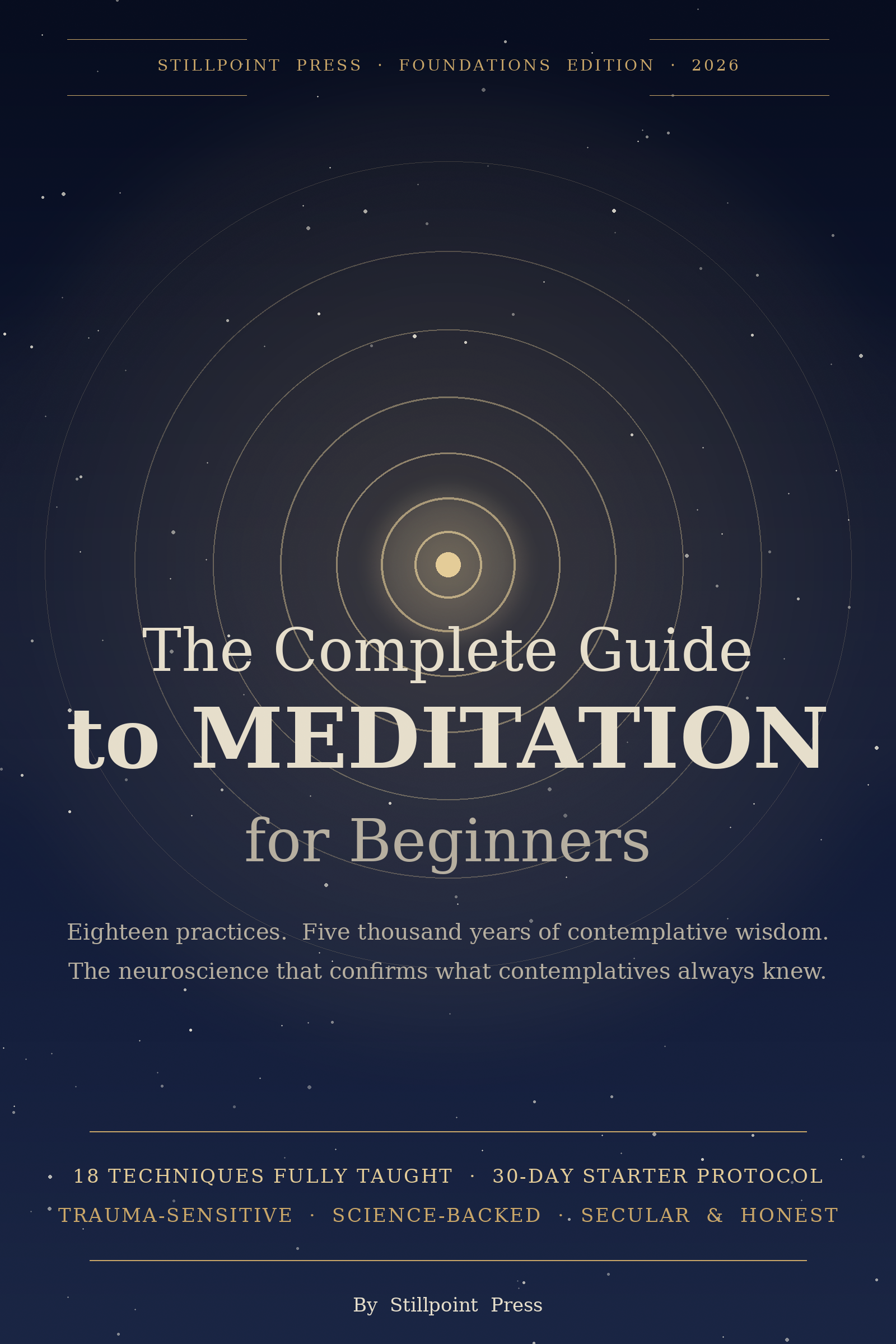
The Complete Guideto MeditationFor the person sitting down for the very first time
Eighteen practices. Five thousand years of contemplative wisdom. The modern neuroscience that confirms what contemplatives always knew. Written for the person who has never sat in silence for more than a traffic light, or who has tried to meditate a dozen times and quit a dozen times. We assume nothing.
Whoever you are. Wherever you are.
Three honest entry points. The book meets you where you actually are, not where you wish you were.
The total beginner
You have never meditated, or you have tried for a few minutes and concluded you cannot do it. You are skeptical that sitting still does anything useful.
Start: Counting → Breath → Body ScanThe curious returner
You have used Calm, Headspace, or Insight Timer. You meditate sporadically. You want to know what a real, lasting practice looks like and how to build one.
Start: 30-day protocol · Habit chapterThe skeptical mind
You are intelligent, busy, and allergic to woo. You want evidence and a method, not a vibe. You will commit only when the cost-benefit is obvious.
Start: Neuroscience · Benefits researchYou can't stop the waves, but you can learn to surf.Often attributed to Jon Kabat-Zinn · Founder of MBSR
Meditation is not a personality test you pass or fail. It is a trainable skill, like learning to play an instrument or to swim.
If you can sit somewhere quiet for two minutes a day and follow the instructions in this book honestly, you can build a meditation practice. The only requirements are willingness and consistency.
Talent is irrelevant. Spirituality is optional. Equipment is none.
Eighteen techniques, fully taught.
Each technique gets its own complete chapter: lineage, the science behind it, posture, instructions, common difficulties, and a practice protocol. Pick one. Stay with it. Or walk through them in order.
Mindfulness of Breath
Body Scan
Loving-Kindness
Vipassana (Insight)
Zen Shikantaza
Mantra Meditation
Visualization
Walking Meditation
Focused Attention (Samatha)
Open Monitoring
Yoga Nidra
Chakra Meditation
Mindful Eating
Self-Inquiry
Tonglen
Counting Meditation
Sound (Nada)
Trataka (Candle Gazing)
A path you can actually walk.
Frequency beats duration. Always. The protocol asks for two minutes a day in week one and grows from there. By day thirty you have a habit, a method, and a measurable change in how you meet your own mind.
Two minutes
Counting meditation. Same time, same chair, every day. The point is showing up, not the duration.
Five minutes
Mindfulness of breath. Notice the wandering. Each return is a repetition. Fifty returns is more useful than five.
Ten minutes
Body scan added on alternating days. The first signs of measurable change in stress reactivity start to appear.
Fifteen minutes
Choose your primary technique. Sixty days from your first sit, you have a real practice that runs without you.
Meditation is not a vacation from your mind.
It is a long, patient acquaintance with it.
From the foundations chapter
What you'll actually get.
Foundations. Neuroscience. Eighteen techniques. The 30-day protocol. Habit design. Common challenges. Tracking. Going deeper safely. Trauma-sensitive throughout.
Foundations
What meditation actually is, what it is not, and the five misconceptions to drop on day one.
Neuroscience & physiology
The default mode network, vagal tone, prefrontal regulation, and the cortical changes documented in long-term practitioners.
Body, breath, environment
Posture that works. Where to sit. Eyes open or closed. The breath as anchor.
The 18 techniques
Each fully taught with lineage, science, instructions, common difficulties, and a practice protocol.
Choosing & sequencing
How to pick the technique that fits you. When to switch. When to stay. How to combine.
Habit design
Time of day, environment, anchoring to existing habits, the science of streaks, and what to do after the first miss.
Trauma-sensitive throughout
When meditation is contraindicated. Modifications for survivors. When to work with a trauma-informed teacher instead of alone.
Going deeper safely
Retreats. Teachers. The dark night phenomenon. The first year. The decade after.
One book. One sitting. A lifetime of practice.
A complete, beginner-honest, science-backed meditation field guide. Instant download. Lifetime updates. Read it tonight, sit tomorrow morning.
- The Complete Guide to Meditation$39
- 30-day starter protocolIncluded
- Trauma-sensitive guidanceIncluded
- Habit design + tracking templatesIncluded
- Lifetime updates & revisionsIncluded
Sit with it. Or it's free.
Take fourteen days with the book. Walk through the foundations. Sit with the protocol. If it does not feel like a senior teacher in the room with you, write to us and we'll refund every cent. No questions, no friction, no follow-up. Keep the book either way. That's how confident we are in the work.
Questions, answered.
I have tried meditating before and gave up. Is this different?
Most people who give up on meditation gave up on the wrong thing. They tried to stop their thoughts, or to feel calm on demand, or to sit perfectly still in a perfectly quiet room. None of that is what meditation is. The book begins with the five misconceptions to drop on day one, then walks you through a method that has carried millions of beginners into a real, sustainable practice. If you can sit somewhere quiet for two minutes, you can do this.
How long does it take to feel a benefit?
Research consistently shows measurable changes in stress reactivity and attention in as little as eight to thirteen minutes per day, sustained for two to three weeks. The book's 30-day starter protocol is designed around that evidence. Most readers describe the first noticeable shift somewhere between day ten and day twenty.
Is this religious?
No. Meditation forms emerged from many religious contexts, but secular adaptations like MBSR, MBCT, and modern attention-training are taught in hospitals, schools, militaries, and Fortune 500 companies. The book teaches the practices honestly with their lineages intact, but you do not have to believe in anything to benefit from training your attention. Spirituality is optional throughout.
I have a trauma history. Is meditation safe for me?
For some people meditation is profoundly helpful. For others, particularly those with unprocessed trauma, certain practices can destabilise. The book contains a full trauma-sensitive chapter explaining when to practise alone, when to work with a trauma-informed teacher, and which techniques to start with and which to defer. Honesty over hype.
What format does the book come in?
You get an instantly downloadable Word .docx file (with PDF available on request). Read on phone, tablet, laptop, or print at home. Includes the full glossary, FAQ, and 30-day protocol as searchable references.
Will I get future updates?
Yes. Every reader joins the lifetime update list. When the science is revised, when new chapters land, when reader-driven additions get added, the new edition arrives in your inbox at no additional cost.
What if it isn't for me?
Write to us within fourteen days and we will refund the full amount. No questions, no follow-up. You keep the book.
Sit down. Begin.
Five thousand years of contemplative wisdom. Eighteen practices fully taught. A 30-day starter protocol you can actually walk. Honesty in place of hype. Yours tonight.
Begin the Practice · $39