
July 2023
Lecanemab (Leqembi)
First anti-amyloid drug to win FDA full approval. Slowed cognitive decline by 27% over 18 months in CLARITY AD.
van Dyck et al., N Engl J Med 2023
Memory, dementia, and the science of a long-sharp life. A calibrated synthesis of the 2024 Lancet Commission, the new biomarker era, and the disease-modifying drugs that finally work — without the supplement-industry grift.
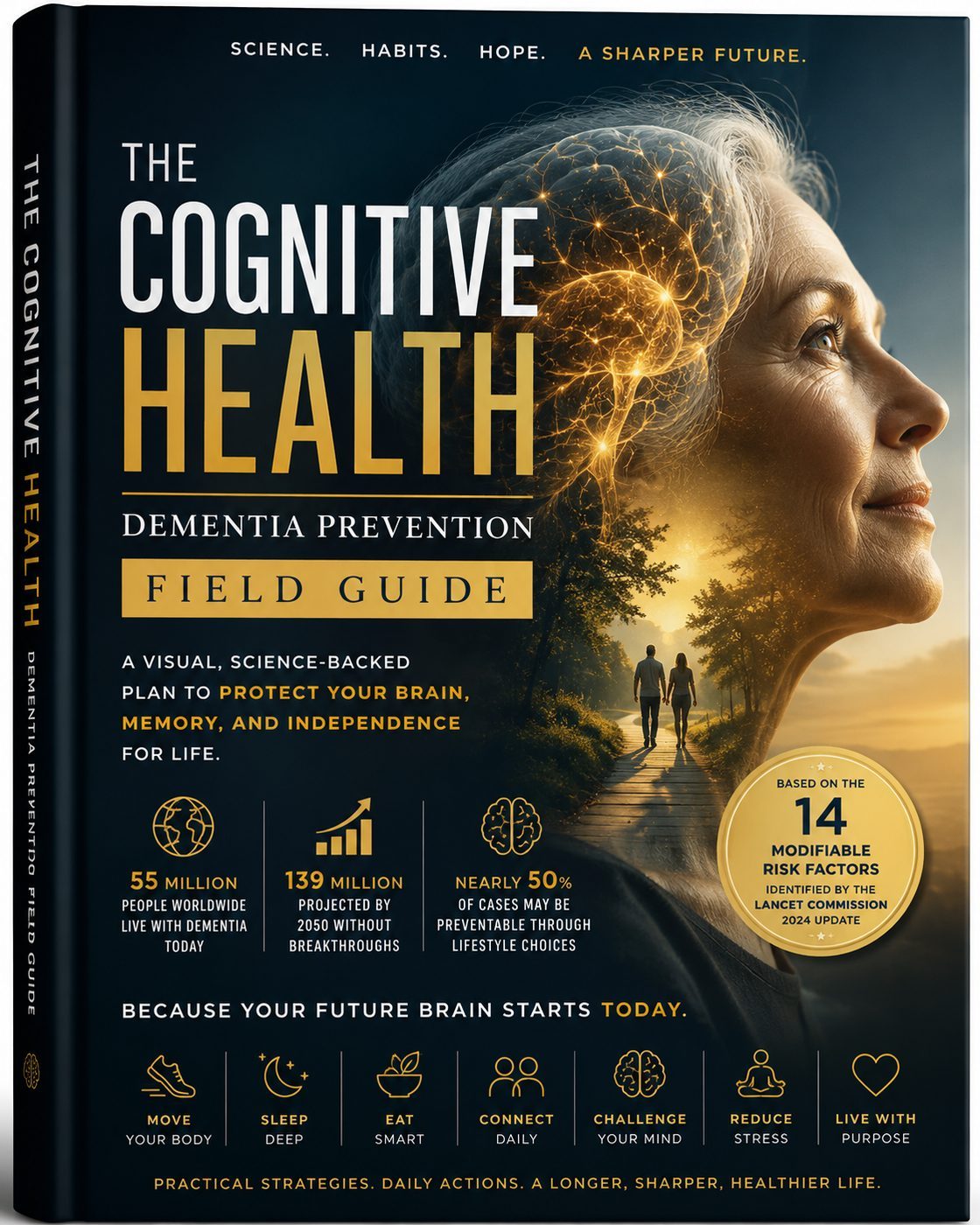
In the last five years the cognitive health field has undergone the most substantial transformation in its history. The 2024 Lancet Commission identified 14 modifiable risk factors accounting for ~45% of global dementia cases. Blood biomarkers like p-tau217 have moved from research to clinical use. Lecanemab and donanemab — the first disease-modifying anti-amyloid drugs — have reached the market.
And yet most consumer-facing books predate this entire era. The shelf is dominated by memoirs, supplement marketing, and "this one habit reverses Alzheimer's" framings that overstate the evidence, sell something at the end, or both. Prevagen built a billion-dollar business on a jellyfish protein. Daniel Amen markets SPECT scans of contested clinical utility. Lumosity settled with the FTC for $2 million over cognitive claims.
Calibrated. Honest. Current. Anti-grift but also anti-nihilism. The synthesis the conversation has been missing.
This is the field guide for the 45-year-old who watched a parent decline. For the APOE4 carrier trying to think clearly. For the partner evaluating treatments. For everyone determined to keep their mind sharp as long as possible — and willing to read something that doesn't sell them a supplement at the end.
From the biology of brain aging to the 14 Lancet risk factors, from sleep to lecanemab, from grift exposed to caregiving — organised so you can read it cover to cover or jump straight to your situation.
Why this book exists. The state of cognitive health today. How the brain actually ages. The research landscape. Sorting science from hype.
The umbrella term. Alzheimer's, vascular, Lewy body, frontotemporal, mixed. The amyloid story. The new biomarker era. Diagnosis when and how.
Each modifiable risk factor in depth — education, hearing, hypertension, smoking, alcohol, depression, isolation, obesity, diabetes, inactivity, pollution, vision, LDL.
The glymphatic brain. Sleep apnea and insomnia. Chronic cortisol. Depression, anxiety, PTSD and cognition. The realistic prescription.
Mediterranean, MIND, DASH compared. Omega-3, B vitamins, vitamin D, polyphenols. Ultra-processed food honestly. Fasting and ketones — the honest cognitive verdict.
Aerobic exercise — the strongest single intervention. Strength, balance, integrated movement. BDNF, exerkines, neurogenesis. Dose-response and the future.
Multivitamins, omega-3, B12, magnesium — honest treatment. Then Prevagen, Lumosity, Amen Clinics, Bredesen ReCODE — what the evidence actually shows.
When to seek evaluation. The full cognitive workup. Lecanemab vs donanemab — qualification, decision framework, costs. Clinical trials. AI in cognitive health.
The personalised strategy. Caring for someone with cognitive decline. Living with decline — the identity dimension. End-of-life and dementia decisions.
Most books for sale to anxious midlife readers are funded by the things they're meant to evaluate. This one isn't. Here's what's in it — and what the evidence actually says.
A jellyfish protein with limited evidence, sold for ~$60/month. FTC and NY Attorney General class-action settlements over deceptive memory claims.
SPECT scans of contested clinical utility for routine cognitive assessment. Marketed at substantial cost with claims exceeding evidence.
FTC settlement: $2 million for deceptive advertising on cognitive improvement and dementia-prevention claims. Modest near-transfer at best.
Limited rigorous published evidence for the broad "end of Alzheimer's" claims made. Significant cost; case-series methodology.
Cognitive engagement matters, but the specific framing — that puzzles prevent dementia — is not supported by RCT evidence.
First disease-modifying anti-amyloid drugs. Slow progression ~27-35% over 18 months. ARIA side effects, ~$26K/year, narrow eligibility.
The single strongest evidence-based intervention. Increases hippocampal volume, raises BDNF, reduces dementia risk substantially at population level.
Best evidence among dietary patterns. MIND-AHEAD trial (2023): modest cognitive benefit. Sustainable; the right baseline for most readers.
If you read a cognitive health book published before 2023, you missed the entire modern landscape. Here's what changed.
First anti-amyloid drug to win FDA full approval. Slowed cognitive decline by 27% over 18 months in CLARITY AD.
Second-generation anti-amyloid. ~35% slower disease progression in TRAILBLAZER-ALZ 2. Once-monthly infusion.
14 modifiable risk factors. ~45% of global dementia cases potentially preventable across the life course.
FDA approved the first plasma p-tau217 ratio. Alzheimer's diagnosis from a blood draw — accuracy comparable to PET.
A 2,111-participant RCT confirmed structured multidomain lifestyle intervention measurably improves cognition in at-risk adults.
Semaglutide and tirzepatide showing potential cognitive protective effects in early trials. EVOKE results expected 2026.
Age 40-65. You've started noticing word-finding moments. You want an evidence-based strategy, not a wellness routine.
Parent or sibling with dementia. Possibly APOE4 carrier. You want to understand personal risk and act on what's actually modifiable.
Watching someone change. You need to navigate diagnosis, treatment options, and the identity dimension of decline.
Considering lecanemab, biomarker testing, GLP-1 for combined benefit. You want a calibrated framework — not a sales pitch.
Knowledge worker, biohacker-curious, considering nootropics. You want the honest verdict on smart drugs and the GLP-1 hype.
Looking for an integrated synthesis of recent literature in one place — evidence-based, citation-dense, patient-counselling-ready.
The fear of dementia is rational. So is the response. Most people who fear it have substantial room to reduce their risk. Most people who develop cognitive decline retain meaningful function and identity for longer than the worst-case popular framing suggests.
Email us within 60 days. Full refund. Keep the PDF. We'd rather lose the sale than have you feel oversold.
No supplement at the end. No protocol you have to subscribe to. Just the field guide most cognitive health conversations have been missing.
❖ Dementia is the most feared health condition of the modern age. In surveys of adults over 45 across more than fifty countries, it consistently ranks above cancer, heart disease, and stroke as the diagnosis people most dread. The reason is not hard to identify. Cancer threatens the body. Dementia threatens the self. The fear is not of pain or even of death but of becoming someone other than who you have been, of forgetting your children’s names, of losing your professional identity, of becoming dependent in ways that obliterate the dignity you have built over a lifetime. That fear is rational. It is also, in important ways, increasingly outdated. In the last five years, the cognitive health field has undergone the most substantial transformation in its history. The Lancet Commission on dementia prevention published its 2024 update identifying fourteen modifiable risk factors that together account for approximately forty-five per cent of global dementia cases, meaning that nearly half of all cases are potentially preventable through addressable lifestyle and medical interventions across the lifespan. Blood biomarkers like p-tau217 have moved from research laboratories to routine clinical practice, enabling diagnosis of Alzheimer’s years before symptoms appear with a simple blood draw. The first generation of disease-modifying anti-amyloid drugs, lecanemab and donanemab, has reached the market, the first treatments in history to actually slow the progression of Alzheimer’s disease rather than merely treat symptoms. GLP-1 medications, originally developed for diabetes and now famous for weight a note Before We Begin
loss, are showing potentially substantial protective effects on cognitive decline in preliminary trials. AI-assisted retinal scans, speech analysis, and digital biomarker tools are detecting cognitive change earlier than ever before. The U.S. POINTER trial published in JAMA in 2025 confirmed what the earlier Finnish FINGER trial suggested: structured multidomain lifestyle interventions can meaningfully improve cognitive performance in at-risk adults. None of this means dementia is solved. The numbers are still sobering. Approximately fifty-five million people globally currently live with dementia, projected to reach one hundred and thirty-nine million by 2050. Alzheimer’s remains the most common cause and the most poorly understood. The new drugs slow progression but do not reverse it. They have substantial side effects and cost approximately twenty-six thousand dollars per year. The Lancet’s forty-five per cent prevention figure is a population-level theoretical maximum, not a guarantee for any individual. Most of the dementia we will see in the next twenty years is already partly determined by exposures and choices of the past three decades. Some forms, frontotemporal dementia, certain genetic variants, Lewy body dementia, remain largely untreatable. And yet the calibrated truth is more hopeful than the public conversation suggests. The brain at sixty is more plastic than nineteenth-century medicine believed possible. The interventions that work, aerobic exercise, sleep, social engagement, hearing aids, blood pressure control, treatment of depression, smoking cessation, alcohol reduction, are unglamorous and well-established, and they work. Most people who fear dementia have substantial room to reduce their risk. Most people will not develop dementia even without intervention. Most people who do develop cognitive decline retain meaningful function and identity for longer than the worst-case popular framing suggests. a note Before We Begin