
Most calming advice asks you to change your life. Box breathing asks for four minutes and nothing else — no app, no equipment, no quiet room. It is one of the few stress tools you can use in a meeting, in a parked car, or in the ninety seconds before a difficult phone call, and no one around you will know you are doing it.
It is also one of the most reliable. Box breathing — sometimes called square breathing — is taught everywhere from military training to therapy rooms, for one simple reason: slowing the breath is one of the fastest ways to tell an overactivated nervous system that it is safe to stand down.
Here is how to do it, when it helps, and what is actually happening in your body when it does.
What is box breathing?
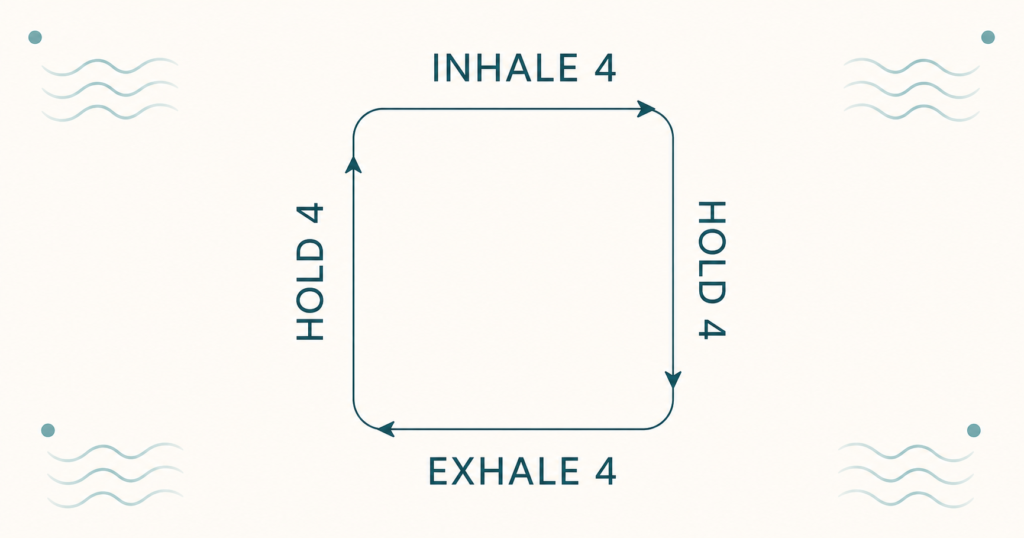
Box breathing is a paced breathing technique built on four equal counts: breathe in for four, hold for four, breathe out for four, hold for four — then repeat. The four equal “sides” are where the name comes from. Each round draws a square.
That is the entire method. The simplicity is the point. There is nothing to remember under pressure, and the steady, predictable rhythm gives your attention something neutral to settle on instead of the thought or situation that set you off.
Box breathing is most associated with high-pressure professions — it is a staple of military and first-responder training — but it belongs to a much older family of slow, paced breathing practices found across yoga and contemplative traditions. The modern name is new. The technique is not.
How to do box breathing, step by step
Sit with your spine reasonably upright; a chair is fine. You do not need to close your eyes, though it often helps.
- Exhale fully. Before you begin counting, let all the air out. This gives you a clean, empty starting point.
- Breathe in for a count of four. Through your nose, slow and smooth. Aim to fill your lower ribs and belly, not just your upper chest.
- Hold for a count of four. Keep your throat and shoulders relaxed — you are pausing, not clamping down or straining.
- Breathe out for a count of four. Through your nose or lightly pursed lips, slow and controlled. Empty completely.
- Hold for a count of four. Rest in the empty pause.
- Repeat for four to six rounds, or roughly four minutes.
Count at a pace that feels steady — about one count per second is typical, but slightly slower or faster is fine. The even rhythm matters more than the exact timing. If it helps, picture your breath tracing the four sides of a square as you go.
Why does box breathing work?
Your breath is one of the very few parts of the autonomic nervous system you can take direct control of, and that makes it a back door into how calm or alert you feel.
Two things are doing most of the work:
- A much slower breathing rate. At four counts per side, one full round takes around sixteen seconds — roughly four breaths a minute, far slower than the twelve to twenty breaths a minute most people take at rest. Slow breathing in this range has been shown to raise heart rate variability and shift the balance toward the parasympathetic — the “rest and digest” — branch of the nervous system. In plain terms, it is the physiological opposite of the stress response.
- The pauses. The two breath holds, together with the long, controlled exhale, gently raise carbon dioxide levels and lengthen the exhale relative to the inhale. A longer exhale is linked to greater vagus nerve activity, which is part of how the body downshifts out of high alert.
It is worth being calibrated here. The broad research on slow, paced breathing for stress, anxiety and blood pressure is genuinely encouraging. Box breathing specifically — the exact 4-4-4-4 pattern — has been studied less than some of its close relatives. What can be said honestly is that box breathing is a well-formed version of slow breathing, and slow breathing works. Treat it as a tool for steadying a moment, not as a treatment for an anxiety disorder.
When should you use it?
Box breathing works best as a deliberate reset rather than a constant background habit. Good moments to reach for it:
- Before something stressful — a meeting, an interview, a hard conversation. Four rounds in the few minutes beforehand.
- In the middle of acute stress — the moment you notice your heart racing or your thoughts speeding up. It is discreet enough to do unnoticed at a desk.
- As a wind-down before sleep — though for sleep, many people prefer a version with a longer exhale (more on that below).
- As a daily anchor — a few minutes at the same time each day, simply to build the skill before you need it.
That last point matters more than it looks. A breathing technique you have practised while calm is one you can actually reach for when you are not. Practising only mid-crisis is like trying to learn to swim during one.
Common mistakes, and how to make it easier
- Forcing big breaths. Box breathing should feel comfortable, almost understated. If you feel lightheaded, you are probably breathing too deeply or too quickly — make the breaths smaller and smoother, not bigger.
- Straining the holds. The pause is a rest, not a test of endurance. Relax your throat, jaw and shoulders through it.
- Starting too long. If a four-count feels like a stretch, start with three. A 3-3-3-3 pattern is still box breathing. Build up over a week or two.
- Expecting a switch. It is a dial, not a switch. You are nudging your system a few degrees calmer — not deleting the stress.
For sleep or stronger anxiety, you can also lengthen the exhale — for example, four in, four hold, six or eight out. A longer exhale leans harder on the body’s calming response, which is why exhale-weighted patterns such as 4-7-8 breathing are popular at night.
Is box breathing safe?
For most people, box breathing is very safe — it is, after all, mostly just breathing slowly and on purpose. A few honest caveats are still worth stating:
- If you are pregnant, or live with a heart or respiratory condition, keep the breath holds short or skip them entirely, and check with a clinician if you are unsure.
- For some people — particularly anyone with a history of panic or trauma — focusing closely on the breath, or holding it, can feel activating rather than calming. That is a real physiological response, not a personal failing. If it happens, stop, open your eyes, and let your breathing return to its own natural rhythm. A practice meant to build calm should never be something you have to grit your teeth through.
There is no prize for pushing past your limit. The right amount of box breathing is simply the amount that leaves you a little steadier than you started.
Going further
Box breathing is the natural first technique in a much larger toolkit — paced breathing for focus, longer-exhale patterns for sleep, more activating practices for energy, and the breath-and-attention work that sits underneath meditation.
If you would rather have the whole map than one technique, The Ultimate Breathwork Guide covers fifteen-plus methods from first principles, with the physiology behind each and a structured way to progress from beginner to advanced. For the wider project of settling a nervous system that runs hot, the Nervous System Relief Toolkit is a natural companion, and The Complete Guide to Meditation picks up where breath training meets attention training.
But none of that is required to begin. Close this page, set a timer for four minutes, and draw a few slow squares with your breath. That is the entire barrier to entry — and it is exactly why box breathing is worth knowing.