
30
chapters across five parts — wine, beer, horilka, the table, the road
The parent guide gave Ukraine's drink seven pages. This is the rest: a long, slow walk through the cellars and brewhouses, the family estates and the bombed-out chateaux, the tap rooms north of Kontraktova Ploshcha — written soberly in wartime, where the war is the weather and the drink is the subject.
One-time payment · Instant PDF · Yours forever · 60-day money-back guarantee.
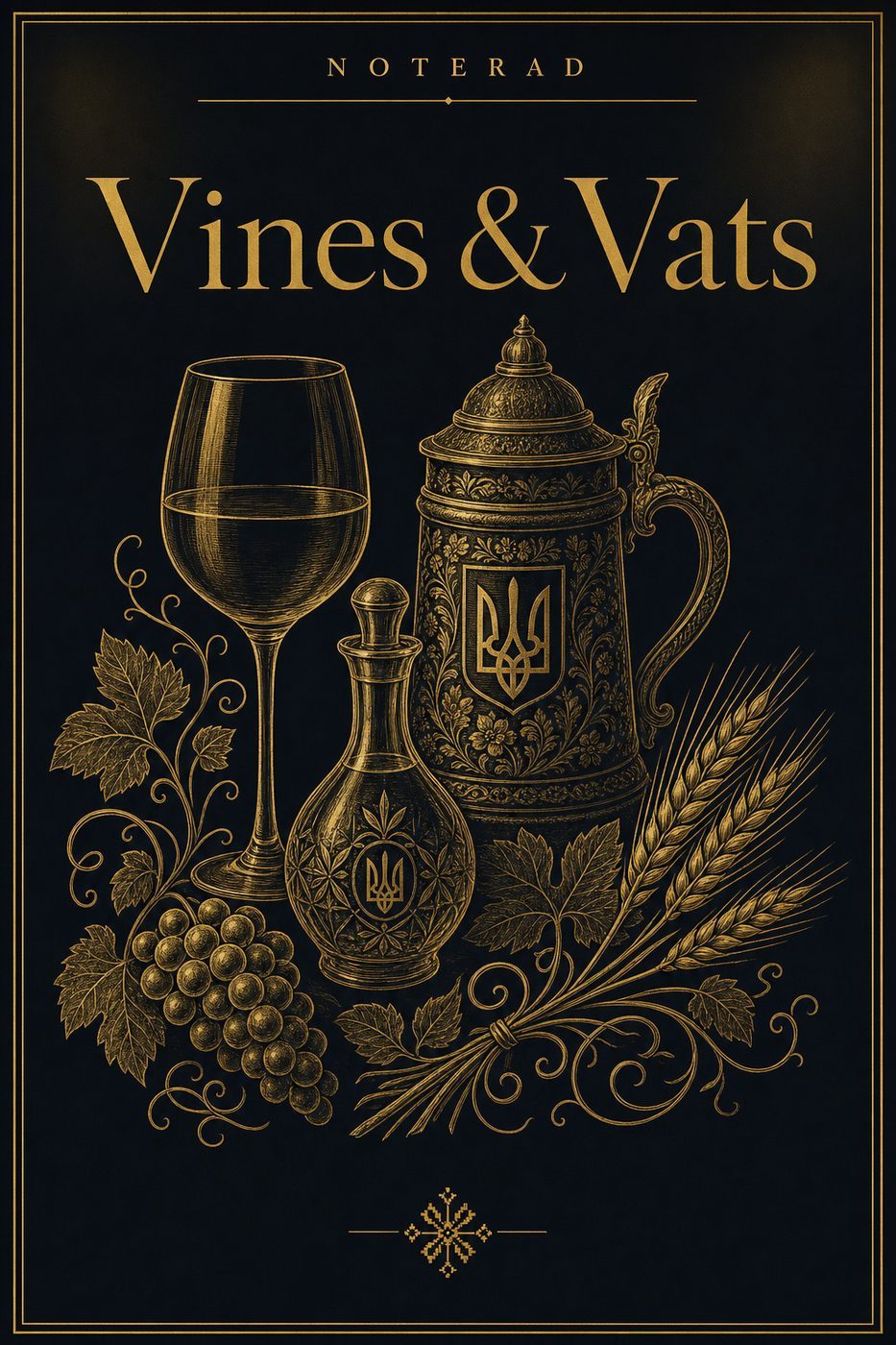
There is a continuous viticultural memory on the northern Black Sea coast reaching back two and a half thousand years — Greek vines, monastery cellars, indigenous grapes that grow nowhere else, breweries older than the border. This book gives each its paragraph, its chapter, its producer a name. The war is in the book. The war is not the book.
Telti-Kuruk and Odesa Black, Bessarabian estates and Zakarpattia's Pannonian inflection, biodynamic projects south of Kyiv — the part of the country's drinking that most outsiders have never tasted.
Lvivske since 1715, Obolon the national stalwart, the craft revolution, and Pravda — the Lviv brewery that turned its bottling line over to Molotov cocktails, then restarted its festival.
The word and the drink at the heart of every supra. Medovukha, nalyvka, samohon, a note on kvas, and the new wave of spirits worth knowing — horilka, never vodka.
None of these drinks make sense without the food. Pairing the Ukrainian table, the seven toasts, and the etiquette that turns a lunch into a four-hour ceremony.
An expanded companion to the Ukraine Traveler's Guide. Read it through for the story, then carry it as reference — every time-sensitive line stamped as of April 2026, every transliteration Ukrainian, never Russian.
One-time payment · Instant digital access after checkout · PDF, yours forever.
Get the book — $39 →Yes. It is a designed PDF you download instantly after checkout and keep forever — readable on phone, tablet, or computer.
No. This is a standalone companion that expands the parent guide's seven pages on drink into a full book. It stands on its own, in the parent's voice, and reads start to finish.
Every time-sensitive line — routes, curfews, prices, vintages — is stamped as of April 2026. Because the country is moving, the book asks you to verify those specifics locally before you travel.
No. Wine is Part One. The book gives equal weight to beer, horilka and mead, the food and the toasts, and a traveler's companion of routes, cellars, and five drinking journeys.
Vines & Vats is educational and cultural writing about Ukraine's drinking traditions, intended for adults of legal drinking age. Please enjoy responsibly. Prices, routes, curfews, and travel conditions are stamped as of April 2026 — verify all time-sensitive information locally before you travel.
A Note on This Book The 2nd edition of the Ukraine Traveler's Guide gave Chapter 18 — Wine, Beer & Spirits — about seven pages. Seven pages is a fine introduction; it is not the country. The reader who finishes Chapter 18 with a Telti-Kuruk on the table and an Obolon in the hand is owed more, and this is the more: a long, slow walk through the cellars and brewhouses, the family estates and the bombedout chateaux, the Soviet-inherited fortifiedwine vaults and the tap rooms north of Kontraktova Ploshcha where a Kyiv pilsner is being poured by a man who fled Donetsk in 2014. Where the parent guide names a producer in passing, this book gives the producer a paragraph; where the parent gives a paragraph, this book gives a chapter; where the parent closes with a line of pairing advice, this book leaves the table open beside you while you cook. The voice is the parent's voice. The transliterations are the parent's transliterations. Every time-sensitive line is stamped as of April 2026, because the country is moving and the reader who picks this up in summer will need to verify a curfew, a route, a price, a vintage. Where the war intrudes — and it does — it is acknowledged soberly and allowed to recede. The drink is the subject. The drinkers are the subject. The bottle on the table is the subject. The country is the bottle. A Note on Names and Spelling The transliteration is Ukrainian, never Russian, and the rule is consistent across both volumes. Kyiv, never Kiev. Odesa, one s, never Odessa. Lviv, never Lvov. Kharkiv, Mykolaiv, Chernihiv, Dnipro. Zakarpattia for the noun, Transcarpathian for the adjective.
Bessarabia for the southern wine country; Bilhorod-Dnistrovskyi for the fortress town below Shabo; Vylkove for the Old Believer fishing settlement in the Danube delta; Kamianets-Podilskyi, Khotyn, Uzhhorod, Ivano-Frankivsk, Chernivtsi, Bukovyna, Hutsul. Where a producer or institution carries a French or English form on its own bottles — Chateau Chizay, Prince Trubetskoy — that form is preserved. The drink is horilka. Vodka is a Russian word, used here only when the contrast is the point, or in compounds — Galician vodka, the Polish-era spirit of the Lviv townhouses — where the older usage is fixed. Foreign words are not italicised: horilka, varenyky, holubtsi, salo, banush, kvas, paska, supra, kotleta po-kyivsky, deruny, medovukha, nalyvka, samohon — all naturalised English here, all in roman type. British spellings predominate: colour, centre, programme, kilometre, favour, organise. Numbers under one hundred are written out in literary passages; figures are reserved for prices, hours, and the specifications the eye wants to find at a glance. One last note. The producers in this book are people. Some are still standing. Some are in uniform. Some have lost their cellars to glide bombs and are starting again with a new label and a new vineyard two regions away. A few names that appear in older promotional material do not appear here because their wartime roles cannot be confirmed. Where this book is silent, the silence is intentional. Foreword: A Toast in a Time of War There is a moment near the end of a Bessarabian lunch — a long lunch, the kind that begins at one in the afternoon with a chilled forshmak and a small glass of something cold and ends near sundown with the plums on the tree across the courtyard turning the colour of wine —