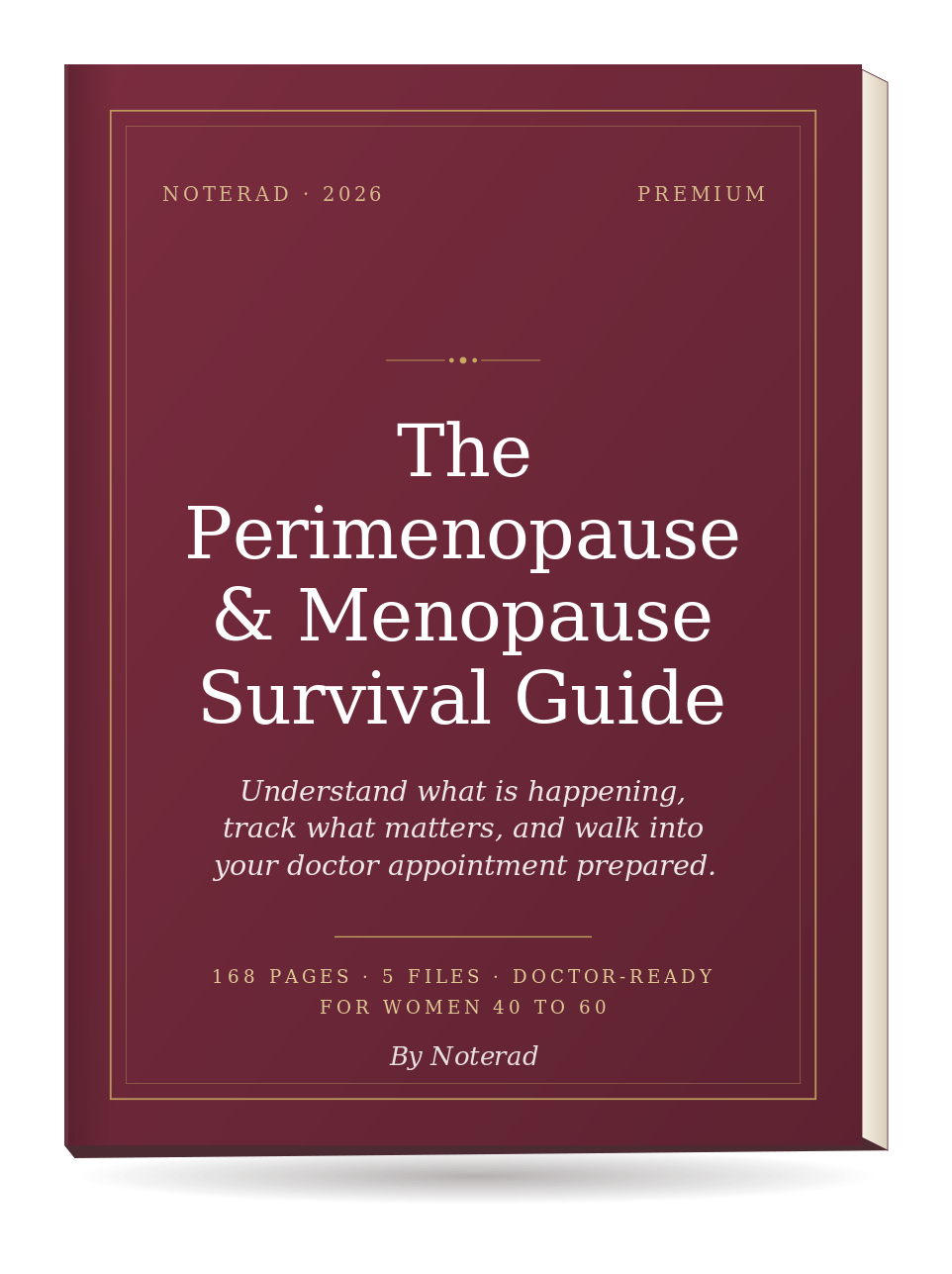
The toolkit between you and a doctor who finally listens. For women 40 to 60 who have been told ‘your bloods are normal’ too many times. Understand what is happening, track what matters, and walk into your next visit with evidence in hand.
Forty per cent of women say their menopause symptoms have affected work. Fewer than ten per cent are offered hormone therapy. The information gap is enormous. This kit closes it.
Designed to be used together. Each one builds on the last. Every page is anchored to the major menopause societies (NICE, the Menopause Society, the British Menopause Society, the Lancet Commission on dementia prevention). No fluff, no fearmongering, no toxic positivity.
The main book. Written as if by a woman who has been through it, with the science to back her up.
Turn vague suffering into patterns over four to twelve weeks. The data your clinician actually needs.
Hand it over at the start of the visit. A clinician can read in seconds what would take you ten minutes to explain.
Turns three files into a guided four-week system, so you know exactly what to do first.
Plus the free 10 Questions guide, included with every order.
Five files. Lifetime access. Print as often as you like.
If the Survival Kit does not give you a clearer plan for your next appointment within 60 days, write to me and you will be refunded in full. No forms, no guilt, no quiz. Your trust matters more than the sale.
No. The Survival Kit is for general education and personal reflection. It is not a substitute for the diagnosis or treatment of a qualified clinician who knows your history. The author is not a physician. The kit is designed to help you have a far better conversation with the clinician you do see.
You receive both PDF and Word (.docx) versions of every file. The PDFs are print-ready. The Word files can be opened, edited, or filled in digitally. Everything works on Mac, PC, iPad, and modern phones.
Yes, if your symptoms suggest the early stages of the transition. Perimenopause typically begins in the mid-forties but can begin in the late thirties. The kit covers the full range, including primary ovarian insufficiency and early menopause. If you are well into your sixties, the long-term health and screening sections are still highly relevant.
Yes. The kit references guidance from the Menopause Society (US/Canada), the British Menopause Society and NICE (UK), the International Menopause Society, the EMAS in Europe, and the Australasian Menopause Society. The clinician directory at the back of the main book lists the right place to look in each region.
Yes. The kit helps you track how you are responding, prepare your review appointment, and understand what to ask if your dose or formulation needs adjusting. It also covers what to expect at two, six, and twelve weeks of treatment.
The kit explicitly covers non-hormonal options, GSM treatment for breast cancer survivors (with the agreement of an oncology team), and the questions to ask. Always discuss your individual situation with your clinical team. The kit will help you prepare those discussions.
Instantly. After checkout you receive an email with download links to all five files. You can also reach the download page directly from the order confirmation.
The kit is licensed for personal use. Please ask anyone who would benefit to buy their own copy at this page; the support keeps the work going and the next edition possible.
You have read the science. You have been tracking your body. You have a list of questions and a sheet with your history on it. This is what advocacy actually looks like. Take your time. Take your kit. Trust yourself.
Get the Survival Kit · $27If you have opened this book, you are probably tired. Tired of waking up at 3 a.m. with your heart pounding and the sheets damp. Tired of crying at adverts. Tired of forgetting the word for ‘fork.’ Tired of the way your jeans fit, of the new shape of your stomach, of being told you look ‘a bit tired’ when you have just slept ten hours. Tired of asking, very quietly, ‘Is it just me?’ It is not just you. It is not in your head, and it is not weakness, and it is not the inevitable price of becoming a woman of a certain age. What you are feeling has a name, and a biology, and in most cases, a treatment that works. I started writing this for myself. I was forty-six and I thought I was losing my mind. My GP told me to try yoga. A wellness influencer sold me an adaptogenic powder for sixty euros. A friend whispered that her sister took ‘something’ and felt much better but she did not know what. The internet, when I went looking, served me either supplements with very nice packaging or articles that
ended with the words ‘talk to your doctor’ as if my doctor had any time at all. So I read. I read the position statements from the major menopause societies. I read the original studies, the boring ones, the ones in journals where the print is small and the conclusions are cautious. I asked friends who are doctors, friends who are scientists, friends who are mothers and daughters and patients. I tried things on myself. Some things helped. Some did not. I changed clinicians more than once until I found one who actually listened. Slowly, the fog lifted, and a calmer, clearer woman emerged on the other side. This book is what I wish someone had handed me at the start. It is the friend who knows the science, who has done the reading, who will not waste your time on ten minutes of toxic positivity or six pages of platitudes. It assumes you are intelligent. It assumes you can handle real information. It assumes you have a life to get back to. I am not a doctor. I will not pretend to be one. I will tell you what the evidence shows, where it is strong and where it is shaky, what the major guidelines recommend, and what to ask for if you want to advocate for yourself. I will tell you what helped me and many of the women I know. And I will tell you the truth about something almost nobody seems to mention. The truth is that the other side of this is good. Not just bearable. Not just survivable. For most women, in time, it is good.
Updated 2026-05-17. Written as an educational Noterad digital guide and reviewed for clarity, safety language, and source quality before publication.
Menopause and perimenopause symptoms can overlap with other conditions. Use this guide to prepare for care, not as a substitute for individualized medical advice.