
New from Noterad — the investing companion to Money, Calmly. Instant download after checkout.
The calm path to wealth

Compound

Own everything. Pay almost nothing. Let time do the heavy lifting.
CompoundingIndex fundsRiskPortfolioBehaviourYour number

There are two stories about how ordinary people get wealthy. The loud one has a hero who picked the winning stock. The quiet one has no hero at all — just thousands of businesses, near-zero costs, automatic contributions, and thirty years of not flinching. This book is the quiet story, told as evidence: what the scorecards show, what a century of crashes did, and exactly what to do about it.

$39

One-time payment · Instant PDF · Yours forever · 60-day money-back guarantee.
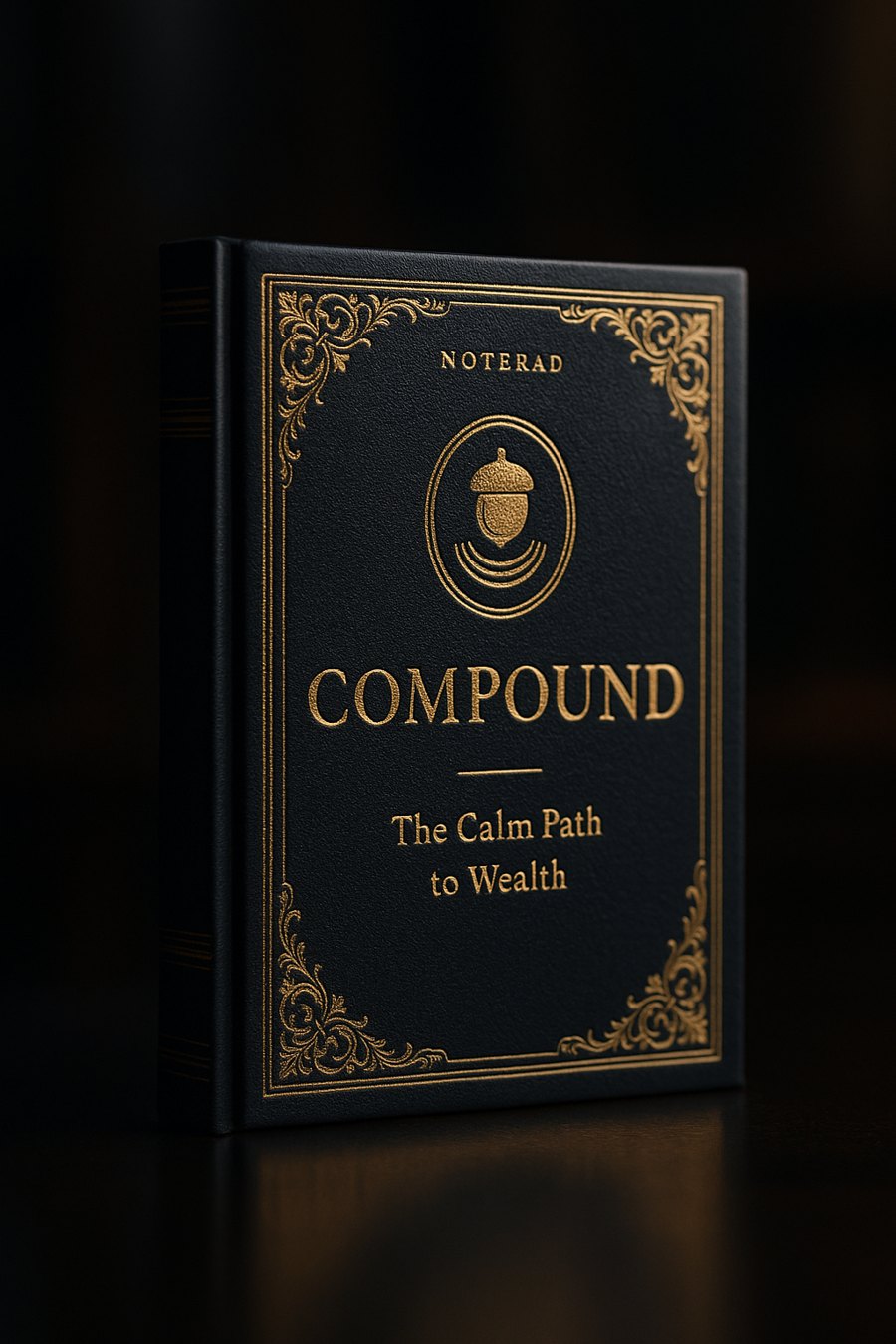
Compound — The Calm Path to Wealth e-book cover
135
typeset pages — 13 parts, a 14-question FAQ, and 4 reference appendices
100%
of the figures are checkable — plain arithmetic or named public research, nothing invented
0
predictions, hot tips, or tickers — a system, not a guess about next year

The evidence points to an almost embarrassingly plain answer.

Over 15-year periods, roughly nine in ten professional US fund managers have underperformed the plain index they are paid to beat — and the average investor earns one to two percentage points a year less than the very funds they hold, through badly timed buying and selling. The conclusion writes itself: own the whole market cheaply, automate everything, and master your own behaviour. This book turns that sentence into a system.

The engine, made visible

Compounding looks like nothing for a decade, then refuses to be ignored. The tables that show the bend — and why starting beats optimising — are worth the price of the book alone.

The case, made fairly

The argument for index funds with the strongest version of the other side answered — scorecards, persistence data, fee arithmetic, and Buffett's own ten-year bet.

Storms, rehearsed

A century of crashes on one honest table, the Japan exception included — plus a literal crash card: what to do, line by line, the night the market drops 8%.

Your number, computed

The 4% rule quoted in full — small print and all — then turned into your own financial-independence number and the savings rate that reaches it.

From first principles to a written plan you can run for decades.

I
See the engineWhat compounding actually is, why the early years feel flat, the cost of waiting, and the three levers that move everything.
II
Stand on solid groundThe five-year rule, the pre-flight checklist, and the universal order of operations — so invested money can stay invested.
III
Know what you're buyingShares, bonds, cash, funds and ETFs in plain English — where returns actually come from, and which job each tool is for.
IV
Build the portfolioAsset allocation, global diversification, the one-, two- and three-fund builds, rebalancing, and your one-page plan.
V
Master the behaviourLoss aversion, the trap gallery, the media diet, and the storm protocol — decided in calm, executed in the crash.
VI
Aim at your numberThe honest 4% rule, years-to-independence by savings rate, sequence risk, and the decade-by-decade lifetime playbook.

Thirteen parts, a 14-question FAQ, four appendices.

Built like every Noterad field guide: short sections, worked arithmetic you can verify with a calculator, self-checks, reflection prompts, and a key takeaway closing every part. Read it once in order; keep it for the night the market turns red.

Parts 1–2 — The Engine & Solid Ground

Compounding made visible, and the pre-flight checks
1Growth that feeds on growth — and the boring middle
1.2The cost of waiting: start at 25, 35, 45, 55
1.3The rule of 72 — and inflation, compounding in reverse
2Scared money, expensive debt, and the order of operations

Parts 3–4 — What You're Buying & Why Indexing Wins

The vocabulary, then the evidence
3Shares, bonds, cash, funds — the bakery, not the ticket
4.1The uncomfortable arithmetic of beating the market
4.2What the scorecards show: nine in ten, over 15 years
4.4The behaviour gap — the enemy in the mirror

Parts 5–7 — Risk, Portfolio & Costs

The price of admission, and the build
5.2A field guide to storms: 1929 to 2022, honestly
5.3The Japan exception — why you own the whole world
6One-, two- and three-fund portfolios; rebalancing; the IPS
7Fees, wrappers and accounts — the only numbers you control

Parts 8–9 — The Investor's Mind & the Storm Protocol

Where the real money is won and lost
8.2The trap gallery: recency, herding, overconfidence…
8.3The financial media diet
9.2The crash card: open when everything is red
9.4Why crashes are sales — for accumulators

Parts 10–12 — Everything Else, Your Number & the Playbook

Honest verdicts, then the lifetime view
10Stocks, property, gold, crypto — and the 5% play bucket
11The 4% rule in full; your number; years by savings rate
11.4Sequence risk — the retiree's storm
12Decade-by-decade playbook and the annual Money Day

Part 13 & Appendices — The Reference Shelf

Answers and tools you'll come back to for years
13FAQ: all-time highs, lump sums, starting at 50, mortgages…
AThe One-Page Plan (Investment Policy Statement)
B–CGlossary · every projection table in the book
DAccounts around the world: US, UK, CA, AU, SE, EU

A complete system — and the temperament to run it.

Worked arithmetic, not vibesEvery projection table is plain maths you can verify — growth, fees, the cost of waiting, sequence risk, years to independence. Gathered again in one reference appendix.
The crash cardA copyable, sign-and-date card for the night the market drops hard: what to do, what not to touch, and who to call. Written in calm, for the other kind of evening.
The one-page planA fill-in Investment Policy Statement — your split, your funds, your rules — so mid-storm you never have to decide, only to read.
Honest verdicts on everything elseIndividual stocks, property, gold, crypto, day trading — each given a fair hearing, a structural verdict, and a sized place (or none) in your plan.

Get Compound — the calm path to wealth.

All 13 parts, from compounding to your number
The crash card — a storm protocol you sign in calm
The one-page Investment Policy Statement template
A 14-question troubleshooting FAQ
Glossary: 40+ terms, decoded in one sentence each
Every projection table in a reference appendix
Accounts around the world: US, UK, CA, AU, SE, EU
135 typeset pages · instant PDF · yours forever
$39

One-time payment · Instant digital access after checkout · PDF, yours forever.

Get the guide — $39 →
60-day money-back guarantee · Instant download · Secure checkout

Clear answers before checkout.

Is this a digital e-book?

Yes. It is a professionally typeset PDF — 135 pages with a full table of contents and clickable chapter outline — downloaded instantly after checkout and yours forever, on phone, tablet, or computer.

Will it tell me which funds or stocks to buy?

No — and it explains why you should be wary of anyone who does without knowing you. It names product types (a global index fund, a broad bond fund) and teaches you to judge any specific one in your country: what it tracks, what it costs, how long it has existed.

How is this different from Money, Calmly?

Money, Calmly is the foundations guide — budgeting, debt, the emergency fund, money stress. Compound is the investing flagship: it goes deep on exactly the things the foundations book only introduces — index funds, portfolios, crashes, and your financial-independence number. They are written as companions; either stands alone.

I'm in the EU / UK / Canada / Australia — does it apply?

Yes. The book is deliberately international: examples are currency-neutral, and the account appendix covers the US, UK, Canada, Australia, Sweden and the EU by name — always pointing you to the current official rules where you live.

Is this financial advice?

No. It is general financial education — it does not know your situation. Investing puts capital at risk and markets fall as well as rise; past performance does not predict future results. For decisions with real stakes, the book itself recommends a regulated, fee-only adviser.

Compound is general financial education, not personalised financial, investment, tax, or legal advice. Investing puts your capital at risk; the value of investments can fall as well as rise, and past performance does not predict future results. Historical figures cited are illustrations, not promises. Tax and account rules differ by country and change — check the current rules where you live, and for decisions that matter, consult a qualified, licensed professional about your circumstances.

From the introduction · free sample

Compound — The Calm Path to Wealth

There are two stories about how ordinary people get wealthy. The loud story has a hero: someone bold who spotted the winning stock, called the crash, got in early on the thing nobody believed in. You hear the loud story constantly — in headlines, in group chats, from an uncle at a wedding — because it's exciting, and because the people it didn't work for don't give interviews.

The quiet story has no hero and worse marketing. In it, a person of ordinary income buys a sliver of thousands of the world's businesses, pays almost nothing in fees, adds money every month with the emotional engagement of a standing order, and ignores the market's moods for thirty years. No genius. No timing. No story, really — which is precisely why it works and why nobody tells it at weddings.

This book is the quiet story, told properly: not as folklore but as evidence. You will see what the scorecards show about professional stock-pickers, what a century of crashes did to people who stayed in versus people who fled, what fees quietly amputate from a lifetime of saving, and what your own brain will try to talk you into along the way.

Keep reading — get the book Instant PDF · 60-day full refund
Join the Noterad Telegram

Early releases, what we're reading, and member-only deals — a few messages a week, no spam.

A 10% welcome code is pinned inside, for members only
Join & get the code