Launch price: $39 today, normally $78. Instant download after checkout.
The complete somatic field guide

The Psoas
Field Guide

Release the muscle that holds your fight-or-flight
SpineBreathGaitPelvic FloorNervous SystemPosture

The deepest muscle in your body is the one nobody taught you to feel. Find it in sixty seconds, release it on your living-room floor, and feel your breath settle two inches lower the same day — with an honest, clinician-aware guide to what actually works.

$39$78Save 50%

One-time payment · Instant PDF · Yours forever · 60-day money-back guarantee.
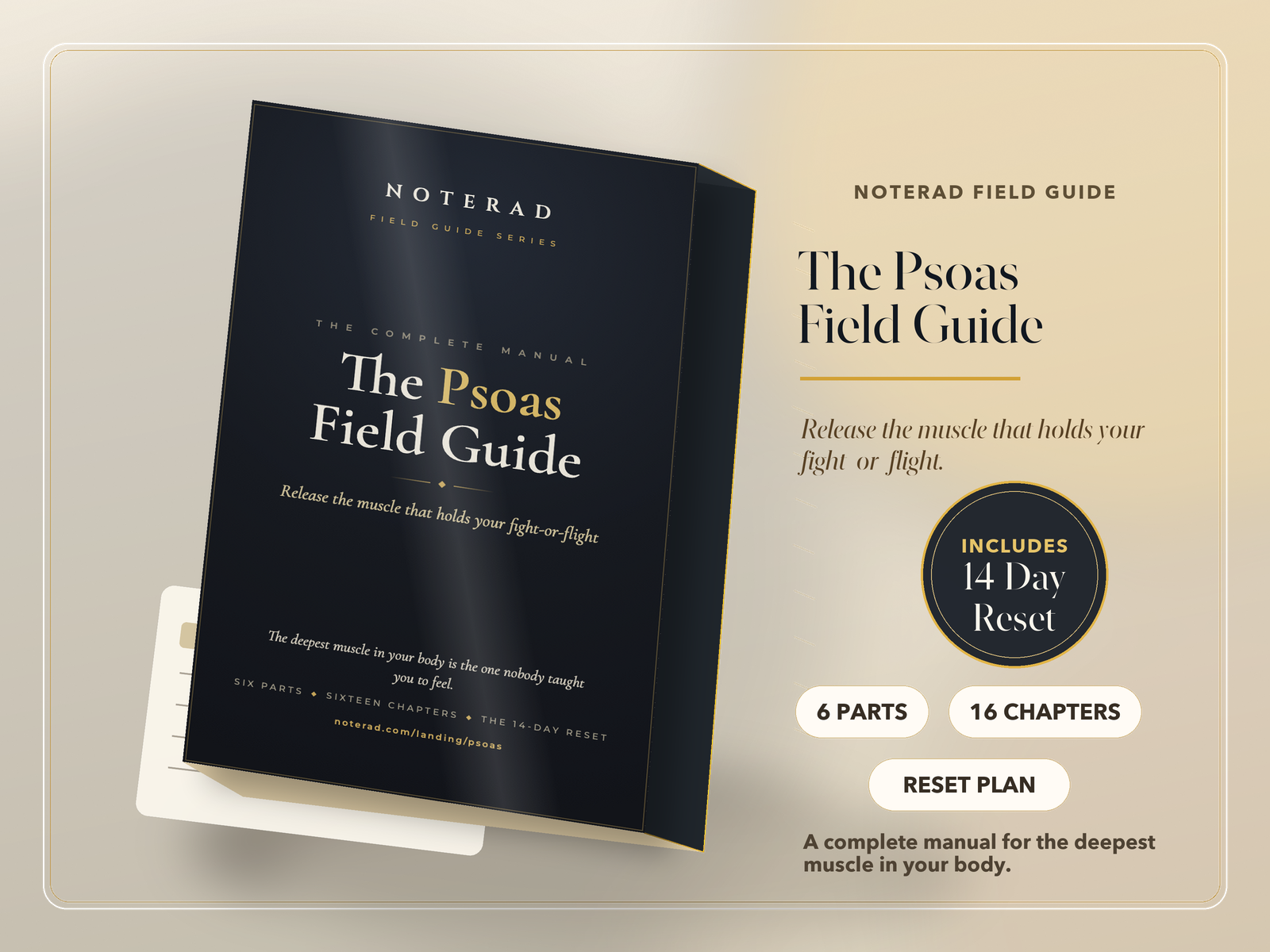
The Psoas Field Guide e-book cover, deep charcoal with gold lettering
16
chapters across six parts — find it, release it, keep it free
5
hand-drawn anatomy diagrams you can actually follow
14
day reset protocol you can start on the floor tonight

One deep muscle, quietly running your back, breath, and nerves.

The psoas major is the only muscle that joins your spine to your legs. When it is short or braced, it pulls on everything above and below it. Most “psoas stretch” videos teach a hip-flexor stretch that never reaches it. This guide teaches the release, the rest position, and why the breath changes.

It connects everything

From the twelfth thoracic vertebra to the top of the femur, it is the lone bridge from spine to leg. Short or braced, it tilts the pelvis and aches the lower back.

Sitting shortens it

Eight to ten hours a day at ninety degrees and the muscle remodels short. The good news: the same adaptability runs in reverse when you give it room.

Stress braces it

The psoas is wired into the fight-or-flight reflex. A nervous system stuck in low-grade threat keeps it gripped — tightness no amount of stretching resolves.

It changes your breath

It shares fascia with the diaphragm through the medial arcuate ligament. Release the psoas and the dome can descend — your breath drops lower the same day.

A method, in six parts, from understanding to everyday freedom.

I
Understand itWhat the psoas actually is, the four myths, and the anatomy nobody taught you.
II
See how it gets stuckThe two different problems — sitting-short and stress-braced — and why each needs a different answer.
III
Trace the connectionsThe psoas–diaphragm–breath link and the psoas–pelvic-floor link, explained simply.
IV
Find and feel itThree sixty-second self-tests that build the felt sense — because you cannot release what you cannot feel.
V
Release itConstructive Rest, the couch and chair release, safe ball work, and active versus passive — in the right order.
VI
Keep it freeThe 14-day reset, walking gait, breathwork, contraindications, and maintenance for a desk life.

Sixteen chapters, in six parts.

A guide built to be read once and used for years. Start with the foundational chapters, run the protocol, and return to the maintenance and contraindication chapters whenever you need them.

Part I — Understanding the Psoas

What it is, where it lives, and why it touches everything
01What the Psoas Actually Is
02The Anatomy Nobody Taught You

Part II — How It Gets Stuck

The two ways a psoas loses its freedom
03Why Sitting Shortens It
04Why Stress Braces It

Part III — The Hidden Connections

Breath and the pelvic floor
05The Psoas, the Diaphragm, and the Breath
06The Psoas and the Pelvic Floor

Part IV — Finding and Feeling It

Building the felt sense first
07Finding Your Psoas in Sixty Seconds
Three self-tests, no equipment

Part V — The Release Practices

From the foundational rest to the advanced work
08Constructive Rest: The Foundational Release
09The Couch and Chair Release
10Ball and Peanut Work, Done Safely
11Active Versus Passive Release

Part VI — Protocol, Movement, and Maintenance

Turning a release into lasting freedom
12The 14-Day Reset Protocol
13Walking Gait and the Freed Psoas
14Integrating With Breathwork
15When Not to Release
16Maintenance for a Desk Life

A practice you can actually keep — minus the mysticism.

The complete release methodConstructive Rest, the ninety-ninety, safe ball work, and active release — taught passive-first, in the order that works.
Honest, clinician-aware guidanceA full contraindications chapter — pregnancy, vascular issues, disc problems — so a gentle practice never backfires.
The 14-day reset protocolA modest, day-by-day plan that convinces the nervous system the braced state was a choice it no longer needs.
Anatomy you can feelFive hand-drawn diagrams and three self-tests that build the felt sense before you try to change anything.

Get the full Psoas Field Guide.

All 16 chapters across 6 parts
The foundational Constructive Rest release
The 14-day reset protocol
5 hand-drawn anatomy diagrams
Breath & nervous-system integration
Full contraindications & safety chapter
Walking-gait and desk-life maintenance
Lifetime updates, read once, use for years
$39$78

One-time payment · Instant digital access after checkout · PDF, yours forever.

Get the guide — $39 →
60-day money-back guarantee · Instant download · Secure checkout

Clear answers before checkout.

Is this a digital e-book?

Yes. It is a designed PDF you download instantly after checkout and keep forever — readable on phone, tablet, or computer.

Will this help if I sit all day?

That is exactly who it is for. Sitting holds the psoas short for hours; the guide is built around small, repeatable resets that undo that pull — including a five-minute desk-life maintenance habit.

Is this just another stretch routine?

No. Most psoas tightness is partly a nervous-system brace, so the foundational technique is a position of rest, not a stretch. The guide explains why stretching an already-protective muscle often makes it worse.

Is this medical advice?

No. It is educational content. There is a full contraindications chapter, and if you are pregnant, have a vascular or spinal condition, or take medication, the guide tells you plainly to clear it with a clinician first.

The Psoas Field Guide is educational content, not medical advice, diagnosis, or treatment. Direct work is contraindicated for some conditions — consult a qualified clinician about your circumstances before changing your routine.